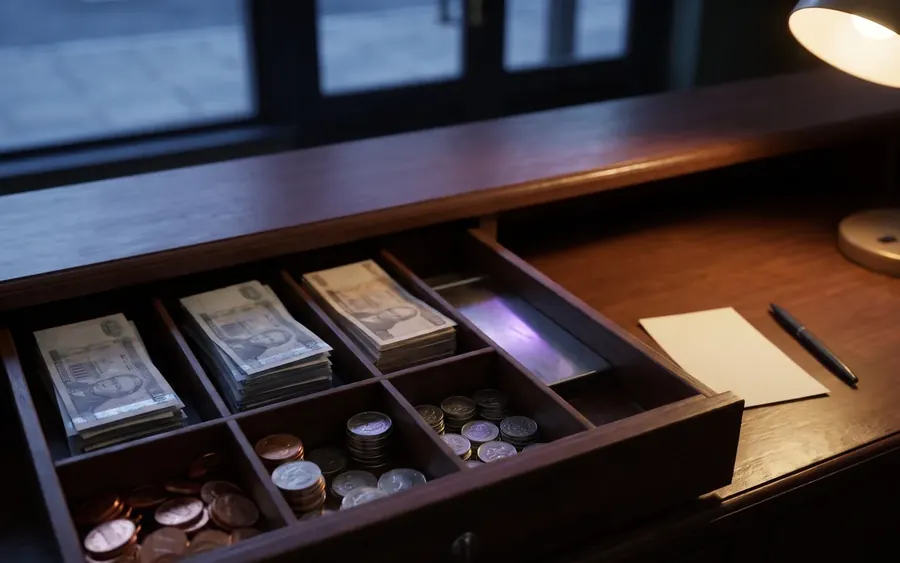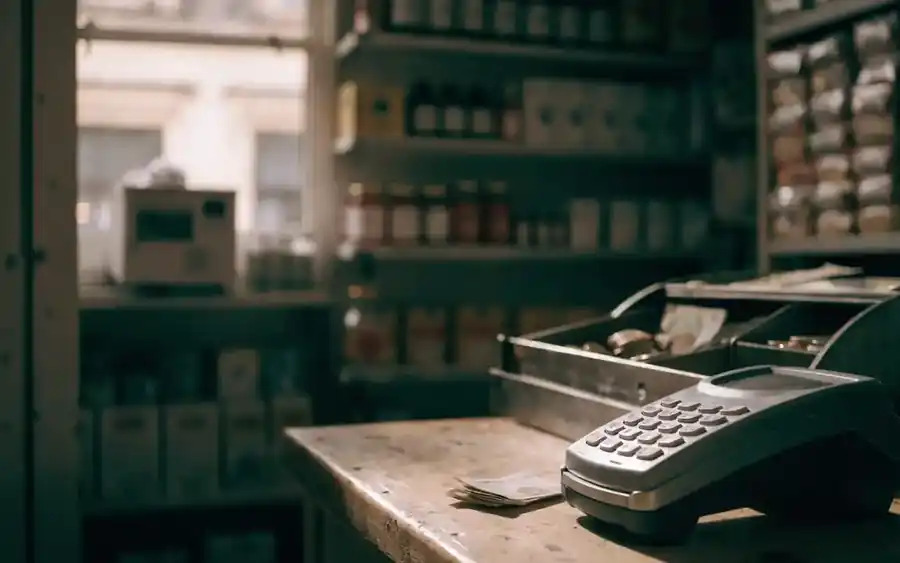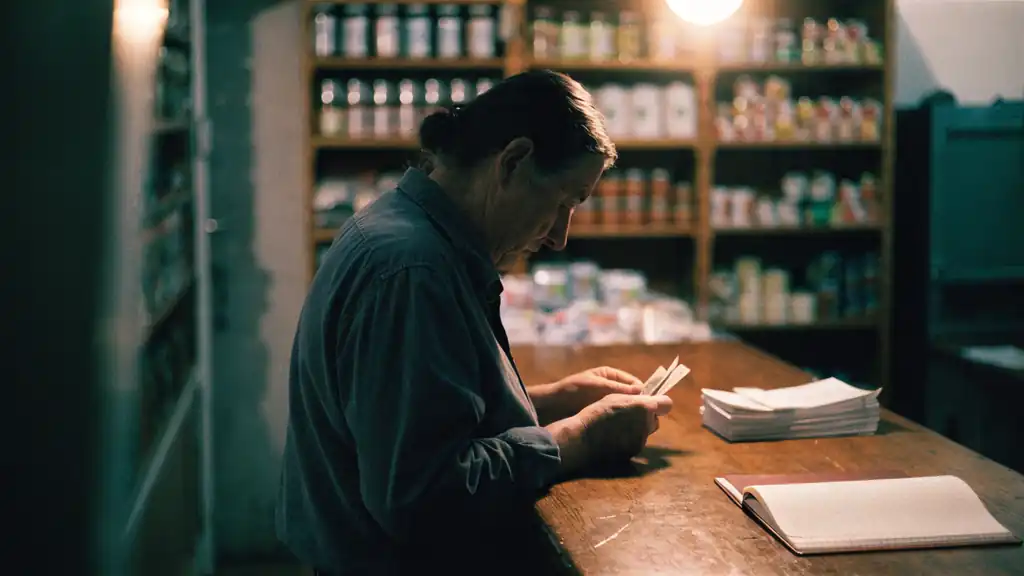
Friday evening, six o'clock. The queue is long, and at the counter a customer puts down a bottle of mineral water and pays with a large note. Meanwhile they're tapping away at their phone, hurrying you because they have to dash, and asking whether you could give the change in smaller notes. The assistant quickly hands over the change, and the note goes into the till. At closing everything adds up — but two days later the bank hands the envelope back one note short.
In most shops a counterfeit note is a rare visitor, and that's exactly what makes it dangerous: nobody expects it, nobody has practised what to look at, and nobody knows what to say. And when one does slip through, it isn't missing from the profit but from the till, at its full value. In many places nobody reimburses this loss, neither the bank nor the insurer.
In this article we go through when the risk is higher, which security features most modern banknotes have, and how to check them at the counter in a few seconds. We show you what to say to the customer if a note looks suspect, what to do if you only find out at closing or when paying in at the bank, how much turnover it takes to replace a counterfeit note, and how to train your team for it. The exact security features differ between currencies and banknote series, so it's worth learning the ones for your currency from the official description published by the issuing central bank. The steps of closing a shift are covered in Shift close and cash reconciliation, step by step, and keeping cash safe in Shop security: cash, closing up, the evening shift and robbery.
Why it's worth dealing with at the counter
For a small shop, counterfeit money isn't a matter for investigation but a counter routine. The aim isn't to turn your assistant into an expert, but for them to check every larger note the same way, in the same order, and to know what to do if something isn't right. That doesn't take an expensive machine, just a little practice and a few clear rules.
- The full amount is lost. A counterfeit note doesn't take away your margin, it takes away its face value. And if the customer paid for a small purchase, you also gave them real money back.
- The loss is usually not reimbursed by anyone. The bank won't credit a counterfeit note, and most insurance doesn't cover it either. Whatever slipped through is the shop's loss.
- You can't pass it on. Almost everywhere it's forbidden to put back into circulation a note you know to be counterfeit, even if that's how you received it.
- Trust within the team. An unexplained shortfall in the till can easily cast suspicion on the assistant. If everyone knows what to check and what the rule is, there are fewer arguments.
- Counterfeiters look for the weak spot. Where it's obvious that every large note gets checked, they try their luck less often.
When the risk is higher
A counterfeit note rarely arrives on a calm morning from a regular's hand. It's far more likely to come when the assistant has no time to look. If you know what these situations are, you'll be more alert exactly when it matters most.
- Peak times and long queues. When the queue is impatient, the assistant wants to speed up, and the note goes into the till without a glance.
- In the evening, in poor light. In weaker light the colours and the watermark are harder to see, and by the end of the day attention is more tired too.
- Holiday trade and market days. There's more cash, more unfamiliar customers, and everyone is in a hurry.
- A large note for a small purchase. If someone pays for chewing gum or a bottle of water with the largest note, the change is real money — this is one of the most common patterns among people paying with counterfeit notes.
- Alone at the counter. If there's nobody to ask for help, it's harder to pause the situation, and the pressure is greater.
- A new or stand-in assistant. Someone who doesn't yet know what to look for, and doesn't dare speak up, is the easiest target.
The typical tricks also rely on distraction, not on a perfect note. The customer hurries you, talks, asks questions, or a second person draws your attention away. It's common for them to change their mind mid-payment, ask for the change in different notes, or ask you to break a large note into smaller ones. It's also suspect if someone pays for small purchases one after another with several large notes, or pulls out a bundle that's suspiciously new and numbered in sequence. None of this is proof — plenty of honest customers are in a hurry — but they are signs that now is the time to look at the note twice.
If an unfamiliar customer asks you to change money without buying anything, or keeps switching notes during payment, the simplest rule is: only one cash movement at the counter at a time. First take the note and check it, hand back the change, close the drawer, and only then talk about anything else. If that makes the customer impatient, that's a sign too.
Banknote security features — what you can check at the counter
Most modern banknotes carry the same types of security feature, even if they look different from one currency to the next. Some you feel with your finger, some you see when you hold the note up to the light, and some only change when you tilt it. Counterfeits often have an imitation of one or two features, but rarely all of them, and rarely in good quality. So the point isn't to look for one sign, but to check several features together.
| Feature | How to check it | On a genuine note | Suspect if |
|---|---|---|---|
| The material | Hold it, bend it gently | Crisp, slightly rough, crackly paper, or smooth, flexible polymer | Soft, limp, shiny or waxy to the touch, creases easily |
| Raised print | Run your finger over the lettering, the numbers or the portrait | Clearly raised under your finger | Completely smooth, or only rough at the edge |
| Watermark | Hold it up to the light | Appears with light and dark shading, visible from both sides | Printed on, sharp-edged, or visible without holding it up to the light |
| Security thread | Hold it up to the light | A dark, continuous line within the note, often with tiny lettering | Missing, broken, or only printed on the surface |
| See-through register or clear window | Hold it up to the light | The patterns on the front and back fit together exactly; on a polymer note, a clean, clear window | The two sides don't line up, the window is cloudy or glued |
| Colour-changing feature | Tilt it | The colour of the number or symbol changes, or a band of light moves across it | Always the same colour, it just glitters |
| Hologram or foil stripe | Tilt it | The image changes, moves, shines sharply | A flat silver stripe that doesn't change, or flakes off |
| Microprinting and sharpness of print | Look closely, with a magnifier | Tiny but legible letters, sharp lines | Blurred dots, letters that can't be read |
The most reliable method is still comparison. If a note looks suspect, put a note of the same denomination that you know is genuine next to it, and look at them one after the other: differences in material, print, colours and watermark stand out far more than they do from memory. A few simple tools help with this too, but none of them replaces your hands and eyes.
| Tool | What it shows | What to watch |
|---|---|---|
| UV lamp | The paper of a genuine note usually doesn't glow under UV light, but the embedded fibres and marks light up in colour | Most counterfeits react differently, but a good imitation can also show a UV mark. Only decide together with feeling the note and holding it up to the light. |
| Magnifier | The microprinting and the sharpness of the print | Slow at peak times; better suited to a second, more thorough check. |
| A note you know is genuine | Every difference in material, colour and print | It's free and always to hand. It's also the best training tool. |
| Automatic banknote checker | Checks several features at once | Useful with a lot of cash, but it has to be set up for your currency and kept updated. |
| Detector pen | Only reacts to certain types of paper | Unreliable on many notes, and doesn't work on polymer at all. Don't rely on it. |
Feel, look, tilt: the quick counter method
At the counter there's no time to go through every feature, and you don't need to. It's enough to check every larger note in the same order, with the same set of movements. Once it's a routine, it takes five to ten seconds, and the customer barely notices, except that you're paying attention. The key is not to check a note as an exception, because then the customer feels accused too, but always.
- 11. Read the situationHow big is the purchase, how large is the note, is the customer rushing you, are they asking for change in smaller notes. If a large note comes with a small purchase, that alone is reason to slow down.
- 22. Put the note on the counter, not in the tillThe note stays on the counter or in your hand until you've checked it and until you've handed over the change. That way it doesn't get mixed up with the others, and there's no argument about which note the customer paid with.
- 33. FeelHold it between two fingers, feel the material, and run your finger over the raised print. A soft, smooth or waxy feel is reason enough on its own to look further.
- 44. LookHold it up to the light and look for the watermark, the security thread, the see-through register or the clear window. These can't be photocopied, only imitated.
- 55. TiltTilt the note and watch whether the colour of the colour-changing feature shifts, and whether the image on the hologram or foil stripe moves. Anything that doesn't change is suspect.
- 66. If anything isn't right: slow down and call a colleagueCompare it with a note you know is genuine, put it under a UV lamp, or ask your colleague to look at it too. If everything is fine, hand over the change, and only then put the note in its place in the till.
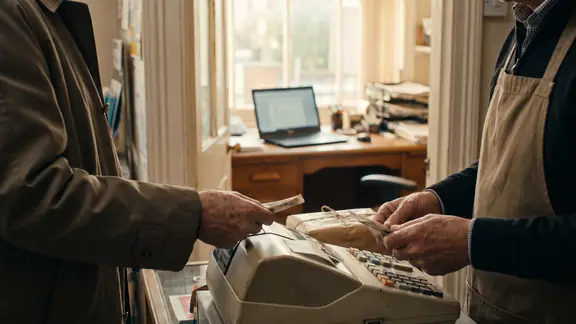
The method works if everyone does it the same way, and nobody gets a funny look for checking a note more carefully. Tell your team: here we check every larger note, regulars' notes and our own included. That way customers don't feel suspected, and the assistant doesn't have to weigh up whose note to check and whose not.
What to do if a note looks suspect
If a note looks suspect, the first rule is to stay calm. The customer who handed it over very often doesn't know themselves that they're carrying counterfeit money: they got it as change somewhere too. If you accuse them, you offend an honest customer, and if you really are facing a counterfeiter, you escalate a tense situation. The aim isn't to judge the customer, but to keep the suspect note out of the till and make sure nobody gets hurt.
| Situation | What to say | What not to say or do |
|---|---|---|
| You're unsure about a note | “Just a moment, I'll take a closer look at this one — we check every larger note.” | “This is fake!” — not while you're unsure, and even then not out loud in front of the queue. |
| You call a colleague | “I'll ask my colleague to have a look too, that's our rule.” | “Were you trying to con me?” — the customer most likely doesn't know themselves. |
| You ask for another way to pay | “I'm afraid I can't accept this note right now. Could you pay by card or with a different note?” | “Where did you get this money?” — offer a solution instead of an interrogation. |
| The local rules say you must keep the note | “I'm sorry, I can't give this note back; under the rules we have to hand it in to be checked. I'll write down when and how we received it.” | Don't threaten, and don't promise anything you can't keep, such as the customer definitely getting the money back. |
| The customer gets upset | “I understand it's unpleasant. We're not blaming you, we just need to check the note.” | Don't argue loudly, and don't draw in the people queuing. |
| The customer wants to take the note and leave | Nothing. Let them go, and write down what you saw. | Don't grab them, don't block their way, don't follow them into the street. |
- Write down what you know straight away: when it happened, which denomination, how much the customer bought, what they looked like, whether they were alone, which way they went. Later you won't remember it exactly.
- Put the suspect note aside in an envelope, and handle it as little as possible. Don't put it back in the till, and don't pass it on.
- If there's a camera above the counter, note the exact time so the footage is easy to find later.
- Tell the shop manager or the owner during the shift, not just at closing.
- If the customer becomes threatening, don't take risks: let them go, and afterwards do what the local rules require.
If you only find out later: at closing or when paying in at the bank
Often it doesn't come to light at the counter but later: at the shift close someone counting feels that a note is odd, or the bank refuses it when you pay in. At that point there's a shortfall in the till of the note's face value, and usually nobody reimburses it. From here the question is no longer how to get it back, but how to record it cleanly, who bears it, and what to learn from it.
- Record the shortfall separately. At the cash reconciliation don't let it disappear into the other differences: note next to it that it's a shortfall from a counterfeit note, which denomination, on which day, in which shift.
- Keep the note or the bank's receipt. If the bank kept it, ask for written confirmation; if it stayed with you, put it aside separately and follow the local rules.
- Try to trace it back. If it comes to light at closing, the assistant on that shift may remember the situation, and you can also look through the large-note payments on the camera footage.
- Don't pay anything out again on a hunch. If a note is doubtful, accept the shortfall rather than slipping it back into circulation.
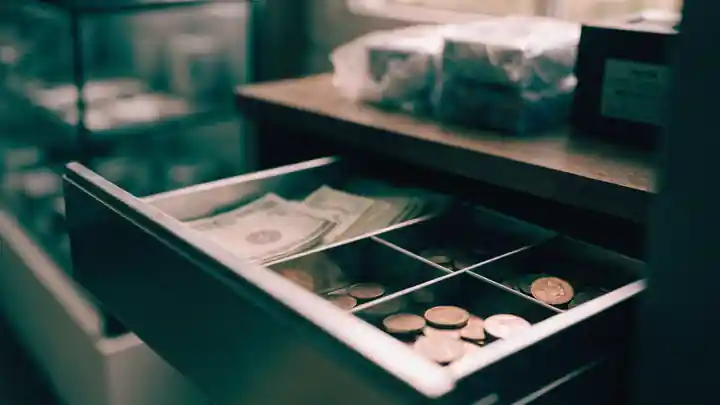
The most delicate question is who pays for the shortfall. This shouldn't be decided on the day of the shortfall, but in advance, and everyone needs to know it. In most shops a counterfeit note is a business risk that the shop bears, especially if the assistant followed the rule and checked the note. Deducting it from the assistant's pay is restricted or subject to strict conditions in many places, so here too the local rules and the employment contract apply. If you blame the assistant without thinking, next time they won't speak up when they find a suspect note, but will quietly make up the difference or hide it.
„A counterfeit note takes your money once. If you blame the assistant for it, it takes something a second time: their trust, and the chance that they'll speak up next time.”
What a counterfeit note costs you
A counterfeit note isn't missing from your profit but from the till, so you have to sell many times its value to replace it. Let's work it out in neutral units. A shop's average margin is 25 per cent, so out of every 100 units of turnover, 25 units remain as profit. If a 100-unit counterfeit note slips through, 100 units are missing from the till, and for that to come back out of profit you need 100 / 0.25 = 400 units of turnover. With an average basket of 8 units that's 50 sales, or a quarter of a day's work in a shop that turns over 1600 units a day.
| Counterfeit note accepted | Shortfall in the till | Needed to replace it (25% margin) | Sales at an average basket of 8 units |
|---|---|---|---|
| 20 units | 20 units | 80 units of turnover | 10 sales |
| 50 units | 50 units | 200 units of turnover | 25 sales |
| 100 units | 100 units | 400 units of turnover | 50 sales |
| 200 units | 200 units | 800 units of turnover | 100 sales |
If you work it out more precisely, the real loss also depends on the purchase. Suppose the customer paid for a 12-unit purchase with the 100-unit counterfeit note and received 88 units of change in real money. The shop lost the 88 units of real money and the goods, whose purchase cost at a 25 per cent margin is 9 units: that's a real loss of 97 units, which takes 97 / 0.25 = 388 units of turnover to replace. In the cash reconciliation, though, the full 100 units show up as a shortfall. Rounded off, then, a 100-unit counterfeit note takes away the profit on roughly 400 units of turnover — that's what a UV lamp and a short training session are worth.
Prevention: training, keeping the till in order, a camera
The best defence against counterfeit notes isn't a machine but a routine. An assistant who knows what to check and isn't afraid to speak up is worth more than any device. Training a new assistant in general is covered in How to train a new shop assistant in 3 days: a 7-step guide; the part about cash is worth adding to it.
- A short practice session with a genuine note. Show every new assistant where the security features are on your currency's notes, and let them feel the note, hold it up to the light and tilt it themselves. Ten minutes, and it stays with them for years.
- The central bank's description, printed out. Keep the issuing central bank's official description of the banknote security features under the counter, so that anyone can check it when they're unsure.
- A UV lamp at the counter. A small lamp isn't expensive, and it makes the second check quick. Keep it where you take large notes, not in the back room.
- A rule for large notes. Decide above which denomination feel, look, tilt is always required, and for how small a purchase you'll accept a very large note. Put it up at the counter as well, so it doesn't look like your personal decision.
- Keeping the till's cash in order. Large notes should go into a separate compartment or under the tray, and there shouldn't be many large notes left at the counter. Taking cash out regularly is covered in the article on shop security.
- Card payment for large amounts. If a customer is paying a large amount, offer card payment. What card and cash each cost you is covered in Card or cash? What each one really costs you.
- If you're unsure, call a colleague. Say this rule out loud, and praise anyone who uses it, even if the note turned out to be genuine.
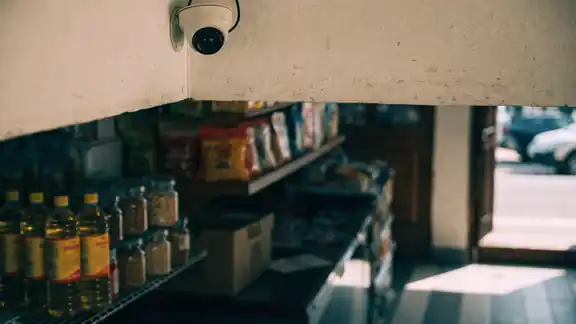
A camera above the counter doesn't filter out counterfeit notes, but it helps afterwards. If a shortfall comes to light at closing, you can look back at the footage to see who paid with a large note, and when. A clearly visible camera is also a deterrent in itself: someone trying their luck with counterfeit money doesn't like being recorded. Where to put the camera and what to watch at the counter is covered in Shoplifting and shrinkage: what can be done from behind the counter.
Common mistakes
- Only checking the suspicious customer's money. If you only check notes now and then, the customer feels accused, and it's precisely the well-dressed, confident customer's money that slips through.
- Relying on a single feature. A shiny stripe or a mark that glows under UV light isn't proof: counterfeits often have an imitation of one or two features.
- Relying on the detector pen. It's unreliable on many notes, doesn't work on polymer at all, and gives a false sense of security.
- Giving change first, checking afterwards. Once the change is in the customer's hand and the note is in the till, it's much harder to sort anything out.
- Accusing someone in front of the queue. You offend the honest customer, you anger the dishonest one, and either way the situation gets worse.
- Playing the hero. No banknote is worth someone getting hurt. If the customer wants to take the note and leave, let them.
- Putting the counterfeit note back into circulation. You can't pass on a note you know to be counterfeit, even if that's how you received it.
- Automatically penalising the assistant. If they followed the rule, the shortfall is the shop's risk. If there's no rule in advance, every case becomes an argument.
Checklist for the shop assistant
This list is worth printing out and keeping under the counter next to the central bank's description. It's short, because at the counter there's no time to read a long policy, but every important step is in it.
- I check every larger note, from everyone, always the same way: feel, look, tilt.
- The note stays on the counter or in my hand until I've checked it and until I've handed over the change.
- Only one cash movement at a time: I only deal with breaking notes or swapping denominations after the payment is finished.
- If I'm unsure, I compare it with a genuine note, put it under the UV lamp, or call a colleague.
- If a note looks suspect, I say so calmly and politely, I don't accuse anyone, and I ask for another way to pay.
- I don't put a suspect note in the till and I don't pass it on; I follow the local rules.
- I write down the time, the denomination and what I saw, and I tell the manager during the shift.
- If the situation turns threatening, I don't take risks: my safety comes before a banknote.
Summary
- Check every larger note the same way: feel, look, tilt — material and raised print, watermark and security thread, colour-changing feature and hologram.
- Don't rely on a single feature; if you're unsure, compare it with a note you know is genuine, or put it under a UV lamp.
- Be most alert at peak times, in the evening, during holiday trade and when a large note comes with a small purchase, especially if the customer rushes you or asks for change in smaller notes.
- If a note looks suspect, stay calm, don't accuse anyone, call a colleague and ask for another way to pay; your own safety comes first.
- The rules on keeping, reporting and handing over counterfeit notes vary from place to place — check the local regulations and ask your bank.
- If you only find out later, record the shortfall separately, and have a rule in advance on who bears it; don't blame the assistant without thinking.
- Replacing a 100-unit counterfeit note takes 400 units of turnover at a 25 per cent margin — training and a UV lamp cost far less than that.
Frequently asked questions
How can you quickly spot a counterfeit banknote at the counter?
The quickest method is feel, look, tilt: feel the material of the note and the raised print, hold it up to the light and look for the watermark and the security thread, then tilt it and watch the colour-changing feature and the hologram. With practice this takes five to ten seconds. Don't focus on a single feature, but on several together, because counterfeits often have an imitation of one or two signs. If anything isn't right, compare it with a note you know is genuine.
What security features do banknotes have?
Most modern banknotes have raised print you can feel, a watermark, a security thread, a see-through register or, on polymer notes, a clear window, a colour-changing feature, a hologram or foil stripe, microprinting and marks visible under UV light. Exactly which feature sits where differs between currencies and banknote series. It's worth learning the ones for your currency from the official description published by the issuing central bank. Print it out and keep it under the counter so the team can see it too.
Is it worth buying a UV lamp for the counter?
A small UV lamp isn't expensive, and it makes the second, more thorough check quick. The paper of genuine notes usually doesn't glow under UV light, but the embedded fibres and marks light up in colour. A good counterfeit can also show a UV mark, so the lamp is an aid, not the decision-maker. Together with feeling the note and holding it up to the light, though, it helps a great deal, especially in the evening and at peak times.
How reliable is a counterfeit detector pen?
A detector pen only reacts to certain types of paper, so it's unreliable on many notes. It doesn't work on polymer notes at all, and a counterfeit on treated paper can pass it too. Its biggest problem is that it gives a false sense of security: because of the pen, the assistant doesn't check the other features. If you use one, let it be just one sign among many, not the basis for your decision.
When is the risk of counterfeit money highest in a shop?
At peak times and with long queues, in the evening in poor light, during holiday trade and on market days, when there's a lot of cash and many unfamiliar customers. A suspect pattern is someone paying for a tiny purchase with a large note, rushing you, distracting you, or asking for change in smaller notes. It's also riskier when a single, new or stand-in assistant is at the counter. None of this is proof, just signs that now is the time to look at the note twice.
What should I say to the customer if a note looks suspect?
Stay calm and polite, and talk about the note, not about the customer. A good phrase is: “Just a moment, I'll take a closer look at this one — we check every larger note.” If it still looks suspect, ask your colleague to look at it too, and ask for another way to pay, such as a card or a different note. Don't say it's fake, and don't ask where it came from, because the customer most likely doesn't know themselves.
Do I have to keep the counterfeit note?
That depends on local rules and differs from country to country: in some places a suspect note has to be kept and handed to the bank or the authorities, elsewhere the procedure is different. Check the local regulations, ask your bank, and write the rule down for the team. If you keep it, tell the customer calmly, and write down when and how you received it. If the situation becomes threatening, your own safety comes before a banknote.
Will I get my money back if I accepted a counterfeit note?
In most places, no: usually nobody pays compensation for a counterfeit note, neither the bank nor the central bank. Most insurance doesn't cover it either. What applies to you is set by the local rules and your insurance policy, so ask your bank and your insurer. The safest thing, then, is prevention: training and careful checking at the counter.
What should I do if we only find out at closing that we accepted a counterfeit note?
At the cash reconciliation, record the shortfall separately, and note next to it that it was caused by a counterfeit note, which denomination, on which day and in which shift. Put the note aside, don't put it back in the till, and follow the local rules. Ask the assistant on that shift whether they remember the situation, and if you have a camera, look back at the large-note payments. The steps of closing a shift are covered in our article on shift close and cash reconciliation.
Can I deduct the value of a counterfeit note from the assistant's pay?
That depends on the local rules and the employment contract, and in many places it's restricted, so ask your accountant. In most shops a counterfeit note is a business risk that the shop bears, especially if the assistant followed the rule. The key is to have a clear internal rule in advance that everyone knows. If you blame the assistant without thinking, next time they won't speak up when they find a suspect note.
How much turnover does it take to replace a counterfeit note?
Divide the shortfall by your margin. In the article's example a 100-unit counterfeit note comes back with 400 units of turnover at a 25 per cent margin, which is 50 sales at an average basket of 8 units. At a 20 per cent margin the same takes 500 units of turnover. That's why training and a UV lamp are worth it, even if only one counterfeit note slipped through a year.
How do I train my assistant to recognise counterfeit money?
Take a note you know is genuine and show the security features on it: let the assistant feel it, hold it up to the light and tilt it. Practise the feel, look, tilt sequence together, along with the sample phrases for the customer. Keep the central bank's description and the checklist under the counter. Say the rule out loud too: if you're unsure, call a colleague, and nobody gets a remark for doing so.
Say the product's name and it's there on the till.
Boltom App takes the work behind the counter off your hands. You find a product by looking at its photo or saying its name out loud — no codes, no scraps of paper. Whatever leaves the shelf or goes in the bin is recorded right there, not in a notebook. It works alongside your existing till, not instead of it.
- A quick code with a photo — or just say the product's name and the till finds it.
- Staff consumption in three taps, recorded under the person's name.
- Daily waste with its reason: expired, broken, unsellable — totalled up in money.
No card needed · 2 minutes