At half past seven in the morning five people are standing at the counter, and the sixth, just opening the door, pauses for a moment in the doorway. They look at the queue, then at their watch, then close the door and walk on. They don't show up in any report: they didn't buy anything, they didn't complain, they simply didn't become your customer. Tomorrow they may buy their bread somewhere else.
In most small shops the queue at peak time isn't inevitable. The problem is rarely that there are too many customers — more often each sale takes longer than it needs to. Ten seconds looking for a code, five for a bag, fifteen counting out coins: each one is a trifle, but over forty or fifty sales in a busy hour they add up, and that is how three people in the queue become seven.
This article is about the queue at peak time as a whole: where the time goes, what to prepare, how to set up the counter, when you need two people, and how to measure whether it got better. Setting up quick codes is covered in detail in How to set up your first 50 quick codes, working out a rota in Shift planning in a shop: keeping wage costs from eating the profit, and the cost of the different payment methods in Card or cash? What each one really costs you. The examples are general and can be adapted to any small grocery, bakery or convenience shop.
Why a queue costs more than it seems
Only part of the cost of a queue is visible: the impatient customer, the sigh, the assistant rushing about. The larger part is invisible, because it is made up of the people who never join it. Someone who sees from the doorway, or already through the window, that five or six people are waiting quickly works out how many minutes it will take, and if they're in a hurry, they walk on. This is the "queue through the window" effect: the queue sends customers away not only inside but out on the street too.
- A customer who walks off is more than one sale. If it happens to them two or three times in a row, they move their morning bread or coffee somewhere else, and their afternoon shopping goes with it.
- People who queue buy less. Someone who has waited is in a hurry: they don't look around, don't ask for another coffee, don't grab the chocolate by the counter at the last moment.
- A queue also sours the mood behind the counter. A rushed assistant makes more mistakes, gives change less carefully, and closes up more tired in the evening.
- Peak time is the most valuable time. A customer lost at eight in the morning is worth more than one at eleven, because most of your regulars shop in the rush.
A simple estimate shows the order of magnitude. If in the five hours of the morning and afternoon rush only two or three people an hour turn back at the door, in a shop open six days a week that is sixty to ninety lost sales a week — and that doesn't yet include the people who stop coming back because of it. No report shows this number; you only see it if you count it once.

Where the time goes in a single sale
An average small-shop sale is a few items and is typically over in forty to ninety seconds. If you break it down into steps, it turns out that payment — which most people suspect — is rarely the biggest part. The time is mostly lost in finding and identifying the product, in weighing, and in searching around the counter.
| Step | Typical time | How to shorten it |
|---|---|---|
| Greeting, hearing what they want | 5–10 sec | Greet them and reach towards the counter at the same time; with a regular, say their usual order yourself: "The usual?" |
| Taking the product off the shelf or from behind the counter | 5–20 sec | Keep the twenty most common products within arm's reach; what sells often shouldn't be in the stockroom or low down at the back. |
| Identifying the product at the till (code, price) | 3–30 sec | Quick codes or pictures for unbarcoded goods; looking up a price on a scrap of paper and "how much is this again?" are the biggest time-wasters. |
| Weighing (vegetables, deli, loose goods) | 10–20 sec | Pre-pack weighed goods that sell in the rush into round weights; keep the scales next to the till, not at the other end of the counter. |
| Payment | 5–30 sec | Have the amount already keyed into the terminal while the customer is still packing; contactless is the fastest. |
| Counting out change | 5–15 sec | A full float before the rush; leave the note you were given on top of the till until you've handed over the change. |
| Packing | 5–20 sec | Opened bags to hand; if there are two of you, packing is the second person's job. |
| Questions, chatting | 0–60 sec | A short, friendly answer in the rush; there's time for a longer chat in the quiet hours. |
In most shops identifying the product is the least predictable step. Barcoded goods are found in an instant, but fresh bread, loose vegetables, local products and new lines are not: the shopkeeper tries to remember the code, searches the note under the counter, or calls to a colleague at the back. A search like this can easily take half a minute, and at peak time that half minute comes up in every third or fourth sale. How to build a code system that works well for this is covered step by step in How to set up your first 50 quick codes.
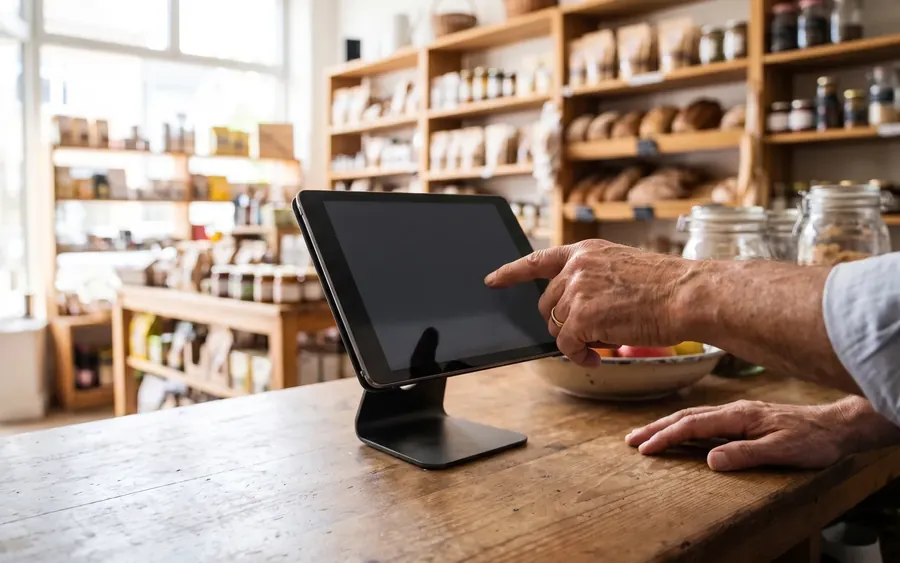
A program by the counter can also help here, one in which you find a product from its photo, a short code or by saying its name — Boltom App, for example, works like this. It's worth knowing that it is not a fiscal till; it runs alongside your existing one. As far as the queue is concerned, the point is that even an unbarcoded product takes no more than a few seconds to identify, even when a new colleague is at the counter.
Preparing before the rush, and the counter layout
How fast the rush goes is largely decided before it starts. Whatever is calmly done ten minutes earlier doesn't have to be done hurriedly in the rush, in front of the customer. It's worth writing these ten minutes into your daily routine, just like opening — The daily routine of a shop: opening, midday, closing gives you a framework for that.
- Change: before the rush, fill the till with coins and smaller notes so you don't have to go to the back for change in the middle of the queue.
- Bags and packaging: opened bags stacked inside each other next to the till, paper bags for bread, napkins for coffee — all within reach.
- Pre-packed fresh goods: pre-pack the bread, cold meats, cheese and vegetables that sell in the rush into the most commonly requested amounts, with the price.
- Restocking the peak-time products: the morning bread, rolls, milk and coffee shouldn't run out on the shelf in the middle of the rush.
- The coffee machine and the slicer should be switched on and cleaned, with spare supplies next to them.
- The card terminal should be charged, switched on, and checked with a test payment to make sure the connection works.
- Don't plan restocking, deliveries or cleaning in front of the counter during the rush — if a delivery is due, ask for it after the peak.
The twenty most common products within arm's reach
The space behind the counter is the most expensive square metre in the shop, because every step here comes out of the queue's time. Look at which twenty or so products are asked for or rung up most often in the rush — bread, rolls, milk, coffee, cigarettes if you sell them, the most popular drink — and arrange the counter so that these are an outstretched arm away from where the till stands. Whatever is rarely needed can go further back, higher up or into the stockroom.
- Stand behind the till and reach for the most common products with your eyes closed. Wherever you have to take a step, something is in the wrong place.
- The scales, the till, the terminal and the bags should be in one line, so the product moves in one direction: shelf — scales — till — bag — customer.
- Only what you need to serve should be on top of the counter. Papers, delivery notes and the phone charger take up the space you need for packing.
- The small items in front of the counter are for the customer, not for you: don't put anything there that makes the customer reach in front of the queue. More on this in Where should everything go? A shop layout that actually sells more.
The "just one loaf" customer
The most sensitive point of the queue is the customer who came in for a single loaf or a coffee while someone in front of them is doing a big shop with weighing. They are the quickest to turn back at the door, even though serving them would take ten seconds. A small shop has no express till, but with a few simple rules you can still give them a fast lane — without anyone feeling that someone was let in ahead of them behind their back.
- A quick spot at one end of the counter: if there are two of you, one takes only the one- or two-item purchases at the end of the counter — pre-packed bread, coffee, a newspaper, a drink.
- Ask, don't decide for them: "Do you mind if I hand over this one loaf in the meantime?" Most customers happily say yes if they're asked, and are put out if they aren't.
- Slot someone in only during dead time: if the big order is being sliced or weighed, serve the quick customer while the machine is working, not in the middle of the big customer's payment.
- A pre-packed breakfast bundle: if half your morning customers ask for the same thing — rolls, milk, coffee — have a ready, priced bundle you can hand over in one movement.
- Visible order: the order of the queue should be clear, with people not crowding in a bunch at the counter. A well-placed shelf or mat sometimes does more than any sign.

„Customers can put up with waiting. What they can't put up with is feeling unseen, or that someone got ahead of them for no reason.”
How to talk to the queue
How a wait feels depends as much on communication as on the minutes. The same three minutes feel shorter if the customer knows they've been noticed and understands why something is taking time. A few habits that cost nothing:
- A glance, a nod or a short "morning, with you in a moment" for everyone who comes in. People who get this turn back at the door far less often.
- If something takes longer — slicing, a stuck payment, a question — tell the queue too: "Just a minute and I'll carry on."
- With regulars, a short, friendly word in the rush, and invite them back for a longer chat in the quieter hours. Most people understand this once you've told them.
- Don't take phone calls in the meantime, and don't deal with anything else in front of the queue — the supplier, a colleague, paperwork.
- If someone has waited a long time, a "thanks for your patience" at the end is worth more than apologising.
Faster payment: card, contactless, cash
Payment is rarely the slowest step, but it's the easiest to speed up. A contactless card or phone payment takes a few seconds if the terminal is in its place and the amount is already keyed in by the time the customer has their card out. Cash is quick with the exact amount, but with a large note and counting out coins it can be the slowest part of the sale. What card and cash cost you overall is worked out in Card or cash? What each one really costs you; here the only question is time.
| Payment method | What slows it down | What you can do |
|---|---|---|
| Contactless card or phone | The terminal is under the counter, the cable is short, you only key in the amount when the customer asks. | Keep it in a fixed place facing the customer; key in the amount while they're still packing. |
| Card with PIN | The customer doesn't expect it, looks for their glasses, forgets the code. | If the terminal asks for a PIN, say so in good time and turn it towards the customer so they can enter it comfortably. |
| Cash, exact amount | The customer starts counting coins at the counter. | Say the total loudly and clearly, before packing, so they have time to get it ready. |
| Cash from a large note | Not enough change, a trip to the back for change, counting more than once. | A full float before the rush; count the change in front of the customer, once, out loud. |
| Mixed or split payment | Two payment methods, two operations, recounting. | In the rush, ask the customer to hand over the cash first and pay the rest by card. |
Two people at the counter: who does what
A second person behind the counter doesn't automatically double the speed. If both do the same thing — serving from start to finish and dodging each other around the till — the gain is small, and it's easy to lose track of who rang up what. Two people only really speed things up when the work is divided: one stays at the till, records and takes payment, the other fetches, weighs, slices and packs.
| Task | First person (till) | Second person (fetching) |
|---|---|---|
| Greeting, hearing what they want | Greets the next customer, keeps an eye on the queue. | Hears the request and is already heading for the product. |
| Taking the product, slicing, weighing | — | Takes it down, weighs it, slices it, hands over a pre-packed one if there is one. |
| Recording | Rings up or selects the product, says the total. | Calls out what they handed over if the till can't see it. |
| Payment | Takes payment, gives the change. | Meanwhile already takes the next customer's request. |
| Packing, handing over | — | Packs and hands over the goods. |
| Quick customers | — | Serves the one- or two-item purchases at the end of the counter if the till is free. |
If both people record sales — because, say, the second one deals with quick customers at the end of the counter — it matters that both devices feed into the same records, otherwise the end-of-day reconciliation won't add up. It also pays for the second person not to stand right by the till but at the other end of the counter, by the shelves and the scales: that way they don't have to dodge each other.
Whether a second person is worth it is not a matter of feeling but of arithmetic: in the hours when a queue regularly forms and customers walk off, a second person usually brings in more than they cost, but on a quiet morning they don't. How to work this out is shown in Shift planning in a shop: keeping wage costs from eating the profit. For a new colleague's first days, Training a new employee on the till in five minutes gives you a script — only put someone on the till in the rush who can already find the most common products without searching.

How to measure whether the queue got shorter
The length of a queue is easy to feel and hard to prove. After a bad morning everything seems slow; after a good one it seems there's no problem at all. For a reliable picture you need three simple numbers, for a week before and a week after the change, on the same days.
- Sales per hour: how many sales there were in each hour. This shows when your rush really is — and it's often not what you remember.
- Time per sale: in the rush, time ten sales in a row with a stopwatch, from the moment the customer steps up to the counter until the next one's turn. The average is what matters, not the fastest.
- Number of walk-offs: one tally mark for every customer who came in or looked in, saw the queue and left without buying. It's the most uncomfortable number, but it shows the real cost of the queue.
These three numbers show how full the counter is. If an hour has forty sales and a sale takes sixty seconds on average, that's forty minutes of pure work out of sixty. On paper that fits, yet in practice a queue forms, because customers don't arrive evenly but in clusters: three at once, then nobody for five minutes. As a rule of thumb, if one person spends seventy to eighty per cent of their hour serving, there will almost certainly be a queue at the busiest moments — then either the sales need to get shorter, or you need a second person.
| Hour | Sales/hour | Time per sale before | Time per sale after | Walk-offs before / after |
|---|---|---|---|---|
| 7–8 | 42 | 62 sec | 48 sec | 5 / 1 |
| 8–9 | 30 | 55 sec | 45 sec | 2 / 0 |
| 12–13 | 24 | 70 sec | 55 sec | 1 / 0 |
| 16–17 | 28 | 65 sec | 50 sec | 2 / 1 |
| 17–18 | 45 | 68 sec | 50 sec | 6 / 2 |

Common mistakes
- The assistant searches behind the counter. In the rush they look up the code or price of a common product on a scrap of paper, from memory or by asking a colleague — the number one cause of queues.
- Deliveries and restocking in the middle of the rush. Boxes stand in front of the counter, the assistant shuttles between the stockroom and the till, and the queue grows.
- An empty float. In the middle of the queue someone has to go to the back for change, or ask the customer for coins.
- The terminal under the counter or in the wrong place. The customer holds out their card, the assistant tugs at the cable, and every payment takes ten seconds longer.
- Two people, but no division of roles. Both serve from start to finish, dodge each other, and nobody watches the queue.
- Not noticing the queue. The assistant looks at the customer, not the queue; people coming in don't even get a nod, and turn back.
- Long conversations in the rush. Three minutes with a friendly regular is three minutes of waiting for everyone behind them.
- No measuring. The shopkeeper decides on a second person or a new counter layout by feel, and doesn't know whether it helped.
A shorter queue in one week: step by step
- 1Day 1: measure where you startWrite down the number of sales per hour, time ten sales in the rush with a stopwatch, and make a tally mark for every customer who left when they saw the queue. This will be your baseline for comparison.
- 2Day 2: find where the time goesLook at the sales you timed step by step: searching, weighing, coins, bags. Pick the two or three longest steps — start with those.
- 3Day 3: rearrange the counterList the twenty products asked for most often in the rush and put them within arm's reach. Put the scales, the till, the terminal and the bags in one line, and clear everything off the counter that isn't needed for serving.
- 4Day 4: write the prep listTen minutes before the rush: change, opened bags, pre-packed fresh goods, a restocked shelf, the terminal switched on. Put the list up by the counter, and ask for deliveries outside the rush.
- 5Day 5: make unbarcoded goods quickGive fresh bread, vegetables and local products a short code or a picture so nobody has to search. Start with the handful of products asked for most often in the rush.
- 6Day 6: divide the rolesIf there are two of you in the rush, agree who stays at the till and who fetches, packs and handles the quick customers. If you're on your own, practise talking to the queue: a nod for everyone who comes in, and a sentence when something takes longer.
- 7Day 7: compare, and decide the next stepMeasure the same three numbers again, in the same hour. If sales got shorter but customers still walk off, the question of a second person comes next; if the walk-offs have gone, keep the routine and measure again once a month.
Checklist
- I know which hours are my rush, and I know it from the number of sales, not from a feeling.
- I've timed with a stopwatch how long a sale takes in the rush.
- I know how many customers leave when they see the queue in an average peak hour.
- The twenty most common products are within arm's reach of the till.
- Before the rush the float is full, bags are to hand, and the pre-packed fresh goods are ready.
- Unbarcoded products have a short code or a picture, and nobody has to search for them.
- The card terminal stands in front of the customer, and the amount is keyed in while they're still packing.
- When there are two of us, everyone knows who stays at the till and who fetches and packs.
- Everyone who comes in gets a glance or a greeting, even when there's a queue.
- There are no deliveries, restocking or paperwork in front of the counter during the rush.
Summary
- The biggest cost of a queue is the customer who never steps in — no report shows them, unless you count them.
- Time is rarely lost at payment; more often in identifying the product, weighing and searching around the counter.
- Ten minutes of preparation before the rush and a counter arranged within arm's reach are the cheapest ways to speed up.
- For fast payment, the terminal needs to be in front of the customer and the amount on its display while they're still packing.
- Two people speed things up when the work is divided; whether it's worth it is decided by working out the rota.
- Measure the result for a week before and a week after: sales per hour, time per sale, number of walk-offs.
Frequently asked questions
How can I reduce queues in a small shop?
First look at where the time goes in a sale, because queues are usually caused not by the number of customers but by sales that drag on. Before the rush, prepare change, bags and pre-packed fresh goods. Put the twenty most common products within arm's reach, and the card terminal in front of the customer. If all that is in place and customers still walk off, it's worth putting a second person on for the peak hours.
How long does an average sale take in a small shop?
For a sale of a few items, typically forty to ninety seconds from greeting to change. A sale with weighing, slicing or many items can take a good deal longer. In your own shop, time ten sales in a row during the rush with a stopwatch and look at the average. That number is your starting point, against which you can see whether the counter got faster after a change.
Where is most time lost at the counter?
In most shops, in identifying the product: with unbarcoded bread, vegetables and local products whose code or price has to be looked up. After that come weighing, searching behind the counter and counting out change. Payment itself is rarely the longest step if the terminal is in the right place. What the biggest item is in your shop, you only find out by watching step by step.
What should I prepare before the rush?
Fill the till with change, put opened bags next to it, and pre-pack the fresh goods that sell in the rush into the most commonly requested amounts. Restock the morning or afternoon staples on the shelf, and switch on and check the card terminal. Ask for deliveries and restocking outside the rush. It's about ten minutes of work that pays for itself many times over during the peak.
When is it worth having two people at the counter?
When a queue regularly forms in the peak hours and customers walk off because of it, even though you've already shortened the time per sale. In those hours a second person typically brings in more turnover than they cost, but not in the quiet hours. The exact calculation is shown in our article on shift planning. It's worth rostering the second person only for the peak hours, not for the whole day.
How should two people split the work at the counter?
It works best if one stays at the till, records and takes payment, while the other fetches, weighs, slices and packs. That way the till is never left empty, and the person behind it doesn't have to go to the shelves. The second person can also take the quick one- or two-item purchases at the end of the counter. If both record sales, make sure both devices feed into the same records.
Can I let someone who's only buying one loaf go first?
Yes, but only by asking the person ahead of them in the queue. Most people say yes to a short "Do you mind if I hand over this one loaf in the meantime?", and appreciate being asked. The best moment for it is when the bigger order is being sliced or weighed. If there are two of you, it's simpler for the second person to take the quick customers at the end of the counter.
How can I speed up card payments?
Keep the terminal in a fixed place facing the customer, not under the counter or on a short cable. Key in the amount while the customer is still packing, so all they have to do is tap. If the terminal asks for a PIN, say so in good time and turn it towards the customer. Before the rush, check with a test payment that the connection is working.
Why does the terminal sometimes ask for a PIN on a contactless payment?
Many places have a limit above which a contactless payment needs a PIN, and for security reasons the terminal may sometimes ask for one on smaller amounts too. This is set by regulation, the bank and the card issuer, varies from country to country, and changes from time to time. It's not the fault of the assistant or the terminal, and it's worth explaining this briefly to the customer. You'll find the exact conditions in your terminal provider's information.
Which products should be within arm's reach at the counter?
The twenty or so products asked for or rung up most often in the rush — typically bread, rolls, milk, coffee, the most popular drinks and the products kept behind the counter. Which ones they are in your shop you'll find out from your sales data or a week of observation. Arrange them so they're an outstretched arm away from the till. Whatever is rarely needed can go further back, higher up or into the stockroom.
How should I talk to people in the queue so they don't get impatient?
Give everyone who comes in a glance, a nod or a short greeting so they know they've been noticed. If something takes longer, tell the queue what's happening and roughly how long it will take. In the rush, keep it to a short, friendly word with regulars too; there's time for a longer chat in the quiet hours. For someone who has waited a long time, a "thanks for your patience" at the end means a lot.
How do I know whether the queue got shorter?
Measure three numbers for a week before the change and a week after, on the same days and at the same hours. The first is sales per hour, the second the average time per sale measured with a stopwatch, the third the number of customers who left without buying when they saw the queue. If sales got shorter and fewer people walked off, the change is working. Try to change only one or two things at a time, otherwise you won't know what made the difference.
Say the product's name and it's there on the till.
Boltom App takes the work behind the counter off your hands. You find a product by looking at its photo or saying its name out loud — no codes, no scraps of paper. Whatever leaves the shelf or goes in the bin is recorded right there, not in a notebook. It works alongside your existing till, not instead of it.
- A quick code with a photo — or just say the product's name and the till finds it.
- Staff consumption in three taps, recorded under the person's name.
- Daily waste with its reason: expired, broken, unsellable — totalled up in money.
No card needed · 2 minutes