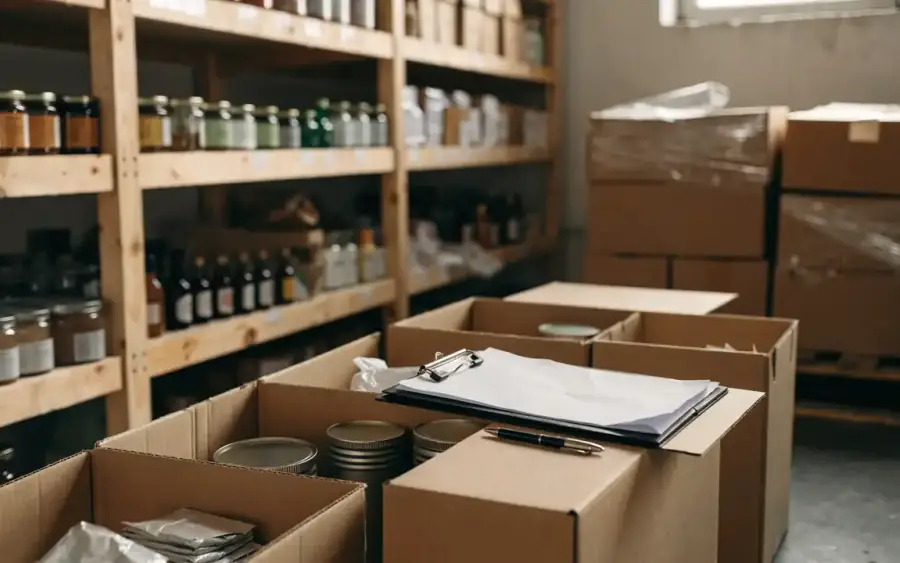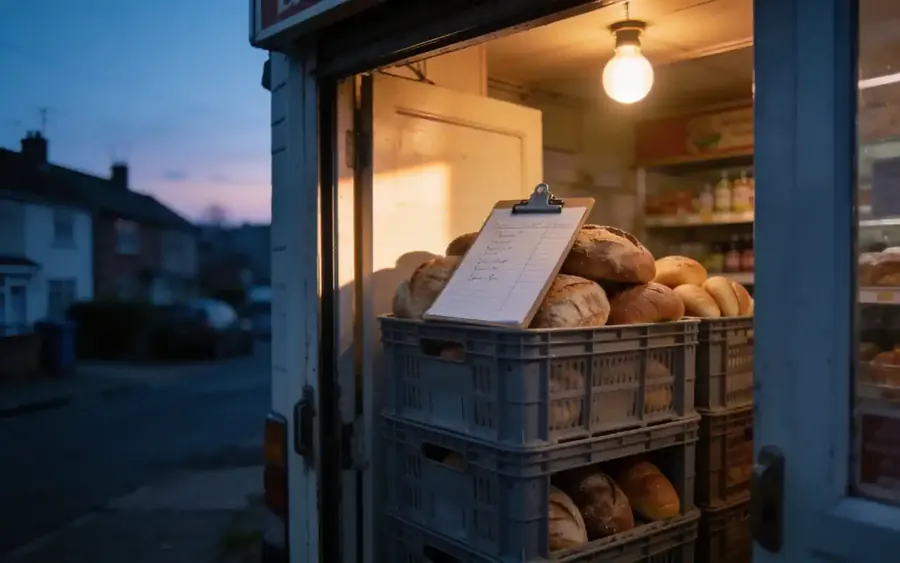
Thursday morning, before opening. The stockroom has run out of mineral water, the wholesaler's next delivery is on Monday, and the crates of bread are already waiting at the door. The shopkeeper looks at the car keys: if they go to the cash & carry now, they'll be back by midday, but until then someone has to stand behind the counter. If they don't go, the water shelf will be empty by the weekend. The same question comes up several times a week, and most shopkeepers decide out of habit, not by doing the sums.
Yet where your stock comes from is one of the biggest decisions in a shop. It determines not only your margin, but also how much of your time goes on buying, how much of your money is sitting in the stockroom, and how often a shelf stands empty. A well-built purchasing mix can save hours and real money every week; a poor one takes both without you even noticing.
In this article we go through the purchasing channels, put them side by side, work out what buying with your own car really costs, and show you how to decide category by category. We deliberately don't name any company, chain or fee, because these vary widely between countries and regions; the examples work in neutral units. Negotiating prices is covered in detail in Suppliers and cost price: how to negotiate, and when to switch, order quantities in Out of stock or overstocked? Finding the balance in a small shop, and taking in deliveries in Taking a delivery step by step — and what the stockroom should look like.
Six routes your stock can come by
A small shop's stock typically arrives from several sources, even if the shopkeeper doesn't think of them as channels. It's worth looking through them consciously once, to see what each route is good and bad at, because only then can you see where you pay extra for convenience, and where you pay for habit.
- Direct from the manufacturer or the brand's sales agent. A sales rep visits you, usually on a fixed ordering rhythm, with delivery. The price for a given brand is often the best, but the minimum order can be high, and you only get that manufacturer's products.
- A wholesaler or distributor with delivery. A wide range from many manufacturers, one order, one invoice, one delivery, often with payment terms. Convenient and predictable, but in return you're tied to a minimum order value and a delivery day.
- Cash & carry, the self-service wholesaler. You go yourself, you load up yourself, you pay on the spot. Flexible, you get the goods straight away, and there are good deals — but the transport, the time and the loading are yours.
- A local producer or small grower. Fresh goods, speciality products, local ties: eggs, honey, vegetables, home-made baked goods. Small quantities, variable supply, often an individual arrangement.
- Online wholesale ordering and platforms. You order through a website from one or more suppliers, with delivery. Convenient, you can order in the evening too, and it's easy to compare prices — but the terms vary widely between platforms.
- Buying up another shop's promotion in an emergency. If something has run out and there's no other way, you buy it on promotion at a bigger shop. Quick, but expensive and risky, so it can only ever be an exception.
For most shops, three or four channels are enough. With fewer, you easily end up dependent on a single supplier; with more, your ordering gets fragmented, the number of minimums, invoices and deliveries grows, and you're not an important enough customer anywhere to get good terms.
Side by side: what each channel offers
The table below shows the typical picture. It's not a rule: there are manufacturers with small minimums, and cash & carries that deliver. But when you're assessing an offer, it's worth going through these points one by one, because the cheapest unit price is by no means always the cheapest way to buy.
| Channel | Price | Delivery | Minimum | Payment terms | Flexibility | Your time |
|---|---|---|---|---|---|---|
| Manufacturer, brand agent | Often the best for those brands | Yes, on a fixed rhythm | Often high, per brand | Often available | Low: tied to rhythm and range | Little: sales rep, delivery |
| Wholesaler with delivery | Medium, depends on volume | Yes, on set days | By order value | Often available | Medium: wide range, but an order day | Little: order, one delivery |
| Cash & carry | Medium, with good deals | None, or for an extra fee | None or small | Usually none, you pay on the spot | High: any time, any amount | A lot: trip, choosing, loading |
| Local producer | Variable, often higher | Often brings it | Small | By arrangement | Medium: set by harvest and season | Medium: arranging |
| Online ordering, platform | Comparable, variable | Yes | Varies by platform | Varies by platform | High: order any time | Little: order, delivery |
| Another shop's promotion | Retail price, expensive even on offer | None | None, but there may be a limit per customer | None | High, but uncertain | A lot, and unpredictable |
One thing stands out in the table: what you gain in one column you often pay for in another. The flexibility of a cash & carry costs your time, a manufacturer's good price costs a high minimum and a fixed rhythm, a wholesaler's convenience costs a few per cent on price. A good decision doesn't look for the cheapest row, but for the one that costs least overall for that particular product group.
With delivery: manufacturer and wholesaler
The delivering channels are the backbone of the shop. The goods arrive on the agreed day, you take them in, and you can stay at the counter meanwhile. A manufacturer or brand agent typically gives good prices and promotions on its own products, sometimes support for shelf placement too, while a wholesaler brings many manufacturers' goods with a single order and a single invoice.
- Ordering rhythm. The sales rep or the ordering system takes orders on set days and delivers on set days. You have to fit your ordering to this: whatever runs out after the delivery day is missing until the next one.
- Minimum order. Many suppliers won't deliver below an order value or a number of cases, or they charge a delivery fee. For a small shop this can easily force you into quantities that are too large.
- One invoice, one delivery. A wholesaler's biggest advantage isn't always the price, but that you deal with one partner instead of twenty manufacturers.
- Returns and complaints. Ask in advance how they handle damaged, missing or expired goods, and how long you have to report them.
One of the biggest advantages of delivering channels, and one that's often forgotten, is payment terms. If the supplier invoices at two weeks, then for two weeks your shelves are full on their money. A shop that buys 1,000 units' worth a week on these terms constantly has roughly 2,000 units of goods financed by the supplier. That's free credit: there's no interest, you don't have to go to the bank for it, and if fast-selling goods are sold before the due date, the money is already in the till by the time you have to pay.
Free credit is only good as long as you handle it with discipline. If you spend the money coming in before the due date on something else, payment day takes you by surprise, and a late payment can worsen your terms too. How payment terms, stock and the till are connected is covered in detail in The shop is profitable and still has no money — stock and cash flow.
Cash & carry: flexible, but not free
The cash & carry is the small shopkeeper's Swiss army knife. There's no order day, no minimum, you buy what you see, and it's on the shelf the same day. You can catch good deals, and you can try out a new product with a single case. That's why many shopkeepers buy almost everything there — and that's exactly the trap.
- Advantage: you get the goods straight away if something has unexpectedly run out.
- Advantage: you can buy in small quantities, so you can try a new product without risk.
- Advantage: you see the deals with your own eyes and can decide on the spot.
- Disadvantage: you pay on the spot, so there are no payment terms, and the money leaves the till immediately.
- Disadvantage: the transport, the loading and the unloading are your work, and meanwhile you either close the shop or someone has to be there.
- Disadvantage: it's easy to buy more than you planned — it's hard to walk past the pallet of special offers.
So a cash & carry is neither expensive nor cheap: it's good for what it was designed for. It's excellent for filling gaps, extra lines, catching deals and trying out new products. As your main source of stock, though, its hidden costs often make it more expensive than the receipt suggests.
The hidden cost: your own time and the car
A cash & carry receipt only shows the price of the goods. What it doesn't show: the journey there and back, choosing, queuing, loading, the fuel, the wear on the car, and the fact that meanwhile the shop is either closed or someone is standing at the counter for you. Let's work it out with an example, in neutral units. A shop buys 1,000 units' worth of goods from this range each week. At the cash & carry it's 3 per cent cheaper, but it takes two trips a week, 2 hours each, and we value your own hour at 15 units. The fuel and wear on the car come to 10 units per trip. The wholesaler delivers the same goods once a week for a fee of 15 units.
| Item | Cash & carry, 2 trips a week | Delivery, 1 order a week |
|---|---|---|
| Purchase price of the goods | 970 units (3% cheaper) | 1,000 units |
| Your time (2 trips × 2 hours × 15 units) | 60 units | 0 units |
| Fuel and car (2 trips × 10 units) | 20 units | 0 units |
| Delivery fee | 0 units | 15 units |
| Total per week | 1,050 units | 1,015 units |
In the example, the cash & carry is 35 units a week more expensive, even though the receipt makes it look 30 units cheaper. Over four weeks, that's 140 units a month. The break-even point is simple: the cash & carry has to be cheaper by the cost of the trips minus the delivery fee you save, that is 60 + 20 − 15 = 65 units. On 1,000 units of purchases, that's 6.5 per cent. If the price difference is smaller than that, delivery is cheaper.
- If a stand-in covers the counter, their time is a cost too. If you pay them for 4 hours at 10 units an hour during the two trips, that's another 40 units, and the cash & carry's weekly cost rises to 1,090 units.
- If the shop is closed while you're out, the lost turnover is lost profit. On a quiet morning that may be little; in a busy hour, a lot.
- If you combine a trip with something else — the bank, the post office, a local producer — part of the cost doesn't belong to purchasing. In that case, split it honestly.
- If the price difference on certain products is large, for example on a good deal, then the cash & carry is worth it. So the question isn't whether you go, but why and how often.
Local producers, online ordering and emergencies
Alongside the three main channels, there are three more that can play a smaller but important role. They're not worth lumping together: one can be the source of what makes you special, another can make ordering easier, and the third is more of a warning sign than a purchasing strategy.
- Local producers. Eggs, honey, seasonal fruit and vegetables, home-made cakes: these let you be different from the big shops. The price is often higher, but customers will pay more too if they know where it comes from. Ask how regularly and how much they can bring, and how you'll get an invoice or receipt for it.
- Online wholesale ordering. You can order in the evening, after closing, it's easy to compare prices, and they often deliver with a small minimum. Watch the delivery fee, the delivery days, and who is responsible if something is missing or arrives damaged.
- Another shop's promotion in an emergency. If an important product has run out, topping it up from a retail promotion is fine once in a while. But a promotional price is still a retail price, there's often a limit per customer, you don't always get a proper receipt for the purchase, and there's hardly anything left on it in your own shop. If it happens regularly, the problem is your ordering or your supplier.
Emergency buying is really a symptom. If it happens several times a month, look at why that product runs out: the order quantity is wrong, deliveries are too infrequent, or the supplier doesn't bring what you ordered. That's no longer a purchasing question but an ordering one, which is covered in Out of stock or overstocked? Finding the balance in a small shop.
The right purchasing mix, category by category
The question isn't which channel is best, but which is best for which product group. A category's sales, margin, shelf life and weight together decide whether it's worth buying by delivery, from a daily supplier, at a cash & carry or from a local producer. The table below is a starting point that you need to tailor to your own shop.
| Product group | Main channel | Supplementary channel | Why |
|---|---|---|---|
| Drinks, mineral water | Wholesaler or manufacturer with delivery | Cash & carry for gaps | Heavy, bulky, sells predictably — carrying it is the most expensive part. |
| Long-life groceries, household products | Wholesaler with delivery | Cash & carry for deals | Many small lines in one order, on one invoice, with payment terms. |
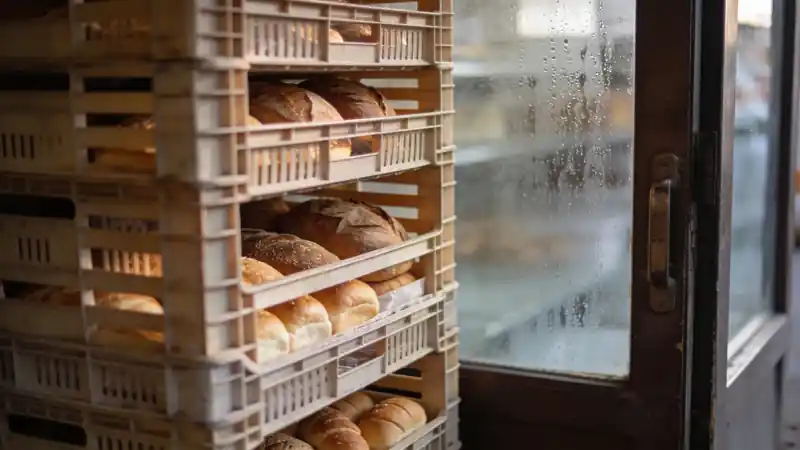
| Bread and baked goods, dairy | Daily fresh supplier | None, or very little | Short shelf life, needed every day, freshness sells it. |
| Fruit and vegetables | Local producer or fresh produce supplier | Cash & carry | Seasonal, quality-sensitive; local produce can be a speciality too. |
| Speciality, local products | Local producer | Small online orders | This is what makes you different from the big shop; small quantities, higher margin. |
| Trying a new product | Cash & carry, in small quantities | Later by delivery | One case shows whether customers want it, before you order a minimum. |
The most important factor in the mix is margin. Where a category's margin is thin — typically drinks and basic long-life groceries — a few per cent difference in purchase price makes up a large part of the profit, and it's worth looking for a better source. Where it's thick, for example on speciality products or fresh baked goods, reliability and quality are worth more than the smallest price difference. How big a category's margin really is can be worked out with the help of What is your margin really? Markup, margin and a shop's true profit.
When to switch channel
A purchasing mix isn't set once and for all. Suppliers' terms change, the area changes, and so does the shop. The signs below suggest it's worth rethinking where a category's stock comes from. If the reason is price, try negotiating first — that's covered in Suppliers and cost price: how to negotiate, and when to switch.
- Persistent delivery problems. Missing lines, wrong goods, delays or damaged packages several times in a row, and complaining doesn't change anything.
- Runaway prices. A supplier's prices rise persistently and without explanation faster than other sources' for the same product.
- A minimum that doesn't fit. Your sales have dropped, and because of the minimum you regularly have to order too much, which sits in the stockroom or goes out of date.
- Changed sales. A category has grown so much that it's now worth buying by delivery, or has fallen so much that topping it up from a cash & carry is enough.
- Too many trips. If you go to the cash & carry several times a week for the same product group, that's a sign it should be coming by delivery.
- A new opportunity. A new supplier has appeared in the area, a producer has widened their range, or an online platform delivers to you with a small minimum.
„A good supplier isn't the one with the cheapest price on the cheapest product, but the one that leaves you with the most at the end of the month — once you count time, the car, gaps and waste.”
Before taking on a new source: a checklist
Taking on a new supplier looks like a small decision, but it can shape how much time and money you spend for months. Before you place the first big order, go through the steps below. A good partner will answer them willingly and in writing.
- 11. Ask for the price list for your own productsNot a hand-picked promotional list, but the regular price for your most important products, and compare it with your current purchase prices. Ask how often and how the price list changes.
- 22. Clarify the minimum and the delivery dayWhat is the minimum order value or number of cases, what's the delivery fee below it, and on which days do they deliver to you? Work out whether it fits your weekly sales.
- 33. Ask about returns and complaintsWhat happens with missing, damaged or short-dated goods, how long you have to report them, and how you get your money back. It's better to know this before the first bad delivery.
- 44. Check the payment terms and invoicingAre there payment terms, and how long, what happens if you pay late, and how, with what breakdown, do they invoice? Tidy invoices are good for your accountant too.
- 55. Have a named contactA name and a phone number you can reach if something is missing or wrong. If you can only write to a general address, a complaint can drag on for weeks.
- 66. Place a trial orderWith a small order of a few products, check whether delivery is on time, whether the invoice matches the price list, and what condition the goods arrive in. A trial order tells you more than any promise.
- 77. Decide which category comes from hereDon't just add the new source; decide which product group it takes over, and where you'll buy less from now on. Otherwise you'll just have one more supplier, and won't reach the minimum with any of them.
Common mistakes
- Too many suppliers. Saying yes to every new offer means many small orders, many invoices and many deliveries, and you're not an important customer anywhere.
- Tiny orders. Delivery fees paid on orders below the minimum and the time spent on many deliveries quietly eat up the price difference.
- Going to the cash & carry every week. Going several times a week out of habit for the same goods, without working out what the time and the car cost.
- Choosing on price alone. Behind the cheapest unit price there may be poor delivery, a high minimum, short dates or awkward complaints handling.
- Forgetting about payment terms. Of two similar prices, the one you pay for later is worth more for your cash flow.
- Turning emergencies into routine. If you regularly top up from retail promotions, the problem is your ordering, not your supplier.
- Deciding about every category at once. Fresh goods, drinks and speciality products need different logic; what's right for one can be expensive for another.
Summary
- There are six purchasing channels: manufacturer, delivering wholesaler, cash & carry, local producer, online ordering and, in an emergency, another shop's promotion; most shops need three or four.
- Don't compare the channels on price alone: the minimum, delivery, payment terms, flexibility and your own time all count.
- The hidden cost of a cash & carry is your own time, the car, and the shop being closed or run by a stand-in meanwhile; in the example, a 6.5 per cent price advantage was needed for it to be worth it.
- Payment terms are free credit, which is good for cash flow — as long as you handle them with discipline.
- Decide category by category: drinks and long-life goods by delivery, fresh goods from a daily supplier, gaps and trials from a cash & carry, speciality products from a local producer.
- Take on a new source only after the checklist and a trial order, and decide which category it takes over.
Frequently asked questions
What's the difference between a wholesaler and a cash & carry?
A wholesaler typically works to order: you place an order, and they deliver it on the agreed day, often with payment terms. A cash & carry is a self-service wholesaler where you go yourself, choose and load up yourself, and pay on the spot. The first is strong on convenience and predictability, the second on flexibility. Many companies mix the two, so always look at the specific terms.
Where is it best to buy stock for a small shop?
Rarely from a single place: for most small shops a mix of three or four channels works best. High-volume goods with predictable sales, such as drinks and long-life groceries, are worth buying by delivery. Fresh goods come from a daily supplier, gaps and extra lines are topped up from a cash & carry, and speciality products are bought from a local producer. Decide category by category, based on your own sales and margins.
Is a cash & carry cheaper than delivery?
On the receipt it often is; overall, not always. A cash & carry trip has a price: your own time, the fuel, the wear on the car, the loading, and the shop being closed or run by a stand-in meanwhile. In the article's example, two trips a week cost roughly 80 units, so despite a 3 per cent price advantage the cash & carry was 35 units a week more expensive. You can work out what it's like for you the same way with your own numbers.
How do I work out whether going to the cash & carry is worth it?
Add up the cost of a week's trips: the number of trips multiplied by the hours per trip and the value of your own hour, plus the fuel and the car. Subtract the delivery fee you save this way. The result is how much cheaper the cash & carry has to be. If you divide it by the value of your weekly purchases, you get the price advantage you need as a percentage — in the article's example, it was 6.5 per cent.
What is my own hour worth in the calculation?
There's no exact figure, but it's certainly not zero. A good starting point is what you would pay a stand-in to cover the counter meanwhile, or what you could earn elsewhere in the same time. If the shop is closed while you're out, count the lost profit too. The point is that your time appears in the calculation, otherwise the cash & carry will always look cheaper.
What is a minimum order, and what should I do if it's too high?
A minimum order is the order value or number of cases below which the supplier won't deliver, or charges a delivery fee. If it's too high, first see whether you can combine several categories into one order from the same supplier. Ordering less often but in larger amounts can also help, if the product's shelf life and your stockroom allow it. If neither works, that product group may be better off with a wholesaler or a cash & carry.
Why are payment terms a good thing?
Because until then the goods stand on your shelf on the supplier's money. If you sell a fast-moving product before the due date, the money is already in the till by the time you have to pay. It's interest-free credit that improves your cash flow, especially on larger orders. The only problem comes if you spend the incoming money on something else in the meantime, and there's nothing to pay with on payment day.
Is it worth ordering direct from the manufacturer?
It's worth it if you sell enough of a brand to reach the minimum comfortably. Manufacturers often give a better price, promotions or shelf support, and the sales rep helps with ordering. In return, the ordering rhythm is fixed and you only get their products, so every manufacturer means another invoice and another delivery. In a small shop it's often only worth it for the one or two best-selling brands.
How do I start working with a local producer?
First ask how regularly and how much they can bring, and what happens in a week when there's nothing. Agree on the price, how you'll pay, and how you'll get an invoice or receipt for it. Start with a small quantity, and watch how it sells. If customers come back for it, local produce can become one of your shop's strengths.
Is it a problem if I sometimes top up stock from another shop's promotion?
Once in a while, in an emergency, it's fine, but it's not good practice. A promotional price is still a retail price, so hardly any profit is left on it in your own shop, there's often a limit per customer, and you don't always get a proper receipt. If it happens regularly, that's a sign the order quantity or the delivery rhythm isn't right. In that case, it's worth sorting out your ordering rather than looking for the next promotion.
How many suppliers should I work with?
There's no general number, but for most small shops one main wholesaler, one or two fresh goods suppliers, a few manufacturers for the strongest brands and one or two local producers are enough, supplemented by a cash & carry. Too few, and you depend on a single partner; too many, and your orders get fragmented and you don't reach any minimum. With every new supplier, decide which category it takes over. If you hardly order from a supplier, consider whether you still need them.
When should I switch supplier?
When delivery is persistently poor and complaining doesn't help, when prices rise faster than elsewhere without explanation, or when the minimum no longer fits your sales. It's also worth rethinking if a category's sales have changed significantly. Before you switch, try negotiating, and bring in the new source with a trial order. After the switch, compare that category's profit in the periods before and after.
Say the product's name and it's there on the till.
Boltom App takes the work behind the counter off your hands. You find a product by looking at its photo or saying its name out loud — no codes, no scraps of paper. Whatever leaves the shelf or goes in the bin is recorded right there, not in a notebook. It works alongside your existing till, not instead of it.
- A quick code with a photo — or just say the product's name and the till finds it.
- Staff consumption in three taps, recorded under the person's name.
- Daily waste with its reason: expired, broken, unsellable — totalled up in money.
No card needed · 2 minutes