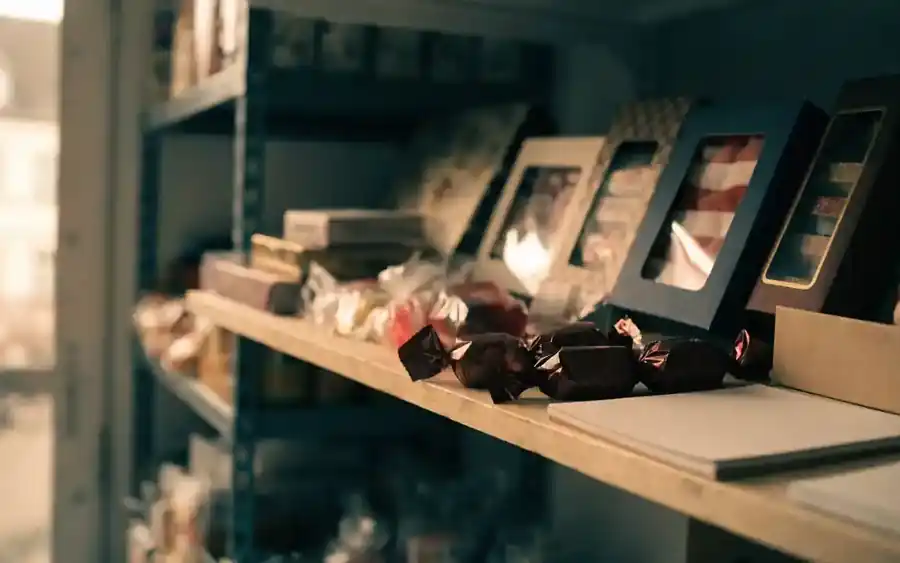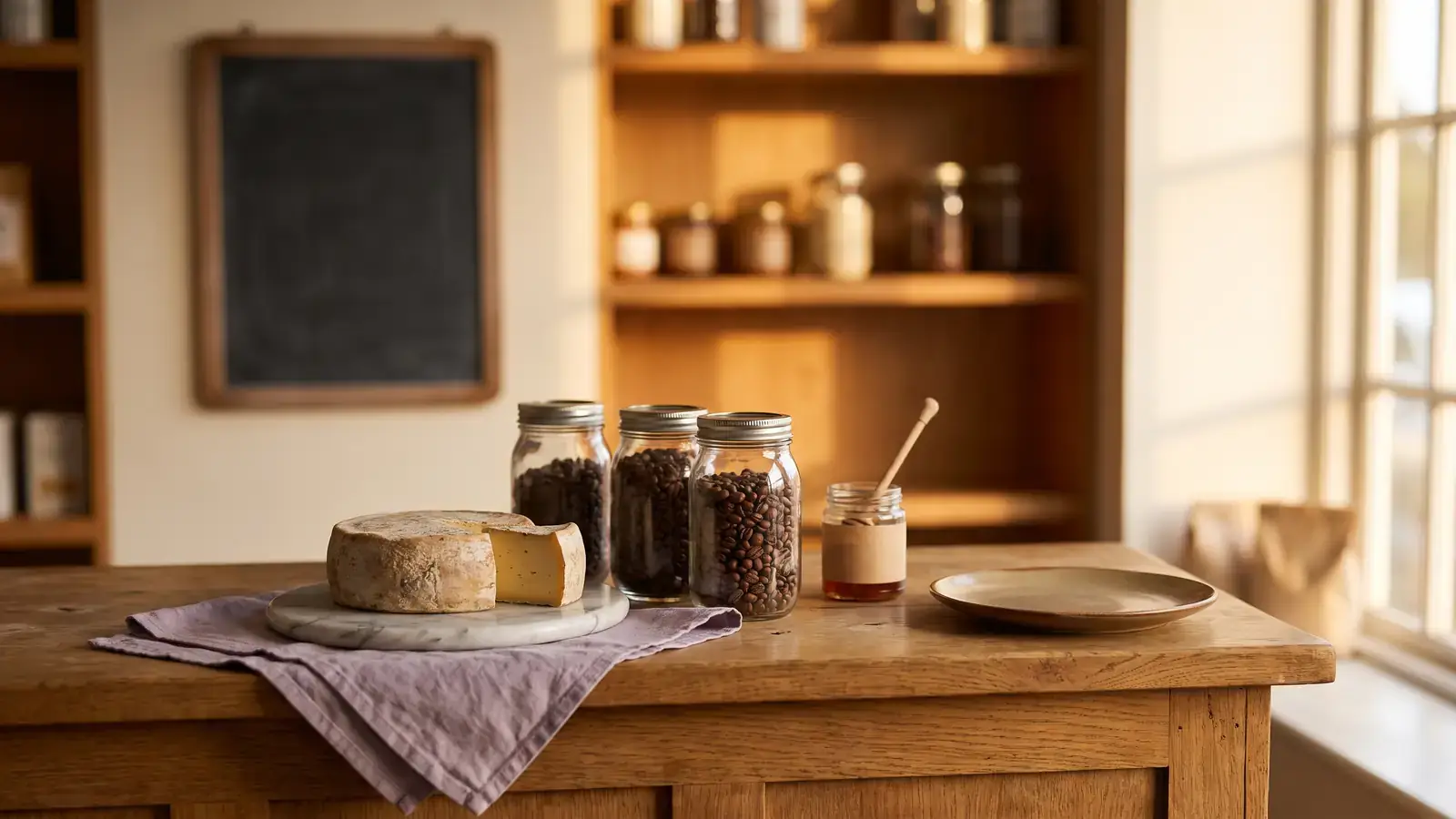
Mid-December, five in the afternoon. A man hurries into the shop in his coat, phone in hand: the office end-of-year party is tomorrow, and he forgot to buy a present for his colleague. He looks around and heads uncertainly towards the chocolate. If there's a nicely wrapped basket by the counter, with a card saying what's inside and what it costs, he pays in two minutes and leaves happy. If there isn't, he buys a bar and goes somewhere else.
The gift pack isn't just a Christmas product. For birthdays and name days, as a thank-you for a teacher or a doctor, for the host of a dinner, for business clients at the end of the year — all year round there's someone looking for "something nice, but quick". In a big store they can choose from dozens of factory gift boxes, but in a small shop they can get something you put together, from the area's favourite products, with a more personal touch.
This article is about how to turn that into good business with little risk: which types of pack to start with, what should go in, how to price, wrap and display them, how to handle pre-orders and business orders, how many to make in advance, and what to do with whatever is left over. The money examples work in neutral units. How much seasonal stock to order is covered in detail in When to place the Christmas order, and how much to order, and the full year-end season plan in Getting ready for the year end: a season plan for your shop from October to January — here we deal only with the packs.
Why gift packs are worth selling
With a gift pack the customer isn't just buying products, but a ready-made solution. They don't have to work out what to buy, they don't have to wrap it, and they don't have to worry that the present will look cheap. In return they're happy to pay more than the same products would cost separately — and that extra is your margin.
- A bigger basket. Someone who would have bought a bar spends several times their usual purchase on a pack, with a single decision.
- A better margin. Wrapping and putting the pack together is added value you can price in; the customer doesn't measure the pack's price against shelf prices, but against how much they want to spend on a present.
- A ready-made solution for the customer in a hurry. In the last few days many people aren't looking for the best present, but for the most convenient one that still looks good.
- Business orders. A company, an office or a club may order ten or twenty packs at once, which for a small shop can be a good day's turnover.
- Showing off local products. In a pack, a local producer's honey, jam or cordial gets discovered by people who would never take it off the shelf.
- Moving slower-selling, good-margin products. A nice bottle of oil or a special tea that sits on the shelf soon sells when it's in the middle of a pack.
At the same time, the gift pack is work and risk. Putting it together takes time, the packaging has to be bought in advance, and whatever doesn't sell has to be dealt with. So the goal isn't as many packs as possible, but a few well-thought-out types that you can put together quickly and whose leftovers you can put back on the shelf.
Types of pack: small, medium, premium
In a small shop, three or four ready-made types are plenty. If there are too many, the customer gets unsure, and you put more packaging and more work into it. It's worth building the types around price bands, because the customer typically arrives knowing how much they want to spend on a present, not what should be in it.
| Pack | Price band | What goes in | Who it's for |
|---|---|---|---|
| Small | 40–60 units | A more special bar of chocolate or a box of biscuits, a small tea or a small jar of jam, in cellophane, with a ribbon. | A colleague, a teacher, a neighbour, a small thank-you, gift swaps within a team. |
| Medium | 90–130 units | One "star" product — good coffee, honey or a special sweet — and three or four companions in a small basket or box. | Family, a friend, a host, a birthday. |
| Premium | 180–250 units | Two or three more special products — local producers' goods, good-quality oil, a drink (minding the age limit) — in a bigger basket, wrapped with more care. | A close family member, an important client, a bigger thank-you. |
| Business | Agreed, unit price depending on quantity | One chosen type with identical contents, in larger numbers, with a matching gift card on request. | Companies, offices, clubs, institutions at the end of the year. |
There should be a noticeable difference between the price bands. If the medium is only a little more expensive than the small, the customer takes the small; if the premium is too far away, nobody touches it — but the medium next to it immediately looks like good value. Why three price levels work this way is explained in detail in Psychological pricing in a small shop. One thing not to forget: the middle pack will be the best seller, so give it the most attention.
What goes in: rules for putting a pack together
A good gift pack isn't the leftovers of the shelf in a basket. It sells itself when it has a centre and a theme, and when every product in it can stand for days, even weeks, in a warm shop and then under a tree. These rules help you avoid most mistakes.
- Long shelf life. Only put in products whose date is months after the holidays — presents often aren't opened straight away, and it feels bad if the recipient finds an out-of-date product inside.
- Products that need no chilling. Cheese, cold meats, fresh cakes and dairy have no place in a ready-made pack standing by the counter. If someone specifically asks for them, that's a pre-order, put together on the day of collection.
- One "star" product and companions. Have one thing that's the centre of the pack — a good coffee, a jar of honey, a nice box of chocolates — and two to four smaller things that go with it. Biscuits and a small chocolate in a coffee pack, jam and tea in a breakfast pack.
- A local speciality. A local producer's product is something the customer won't find in a big store, and it makes the pack personal. If you have one in your range, build on it.
- Age-restricted products only with care. A drink can go in a pack, but the same rules apply as on the shelf: you can't sell it to a minor, and local rules may require more. Have an alcohol-free version too, and mark clearly on the pack if there's a drink inside.
- Ingredients and allergens. Once you seal the pack, the customer can't see the products' labels. Add a small card listing the contents, and mark the common allergens — walnuts, hazelnuts, gluten, milk.
- Strong scents and fragile items. Don't put soap or candles next to food, because it takes on the smell, and don't put glass against glass without padding.
Drinks deserve special attention. A bottle of wine or a special drink adds a lot to a premium pack's value, but an age-restricted product is still age-restricted inside a pack: whoever collects it at the counter has to have their age checked just like with an ordinary purchase. This is covered in detail in Alcohol and tobacco at the till: age checks, asking for ID and how to say no. For business orders, ask in advance whether they want an alcohol-free version — at many workplaces that's the rule.
Pricing: how to work out the price of a pack
The most common mistake is for the shopkeeper to add up the products' shelf prices and charge that for the pack, or even give a discount on it. That way the basket, the cellophane, the ribbon and half an hour's work go for free, and you earn less on the pack than if you'd sold the products separately. Build the price of a pack from four items: the purchase price of the products, the packaging, the labour, and the margin on top.
| Item | Amount | What's in it |
|---|---|---|
| Purchase price of the products | 60 units | One "star" product and four companions, at purchase price. |
| The same products separately on the shelf | 85 units | What you'd sell them for one by one — that's 25 units of profit. |
| Packaging | 10 units | Basket 6, cellophane and filling 2, ribbon and label 2. |
| Labour | 5 units | About 20 minutes to put together, counting 15 units an hour. |
| Total cost | 75 units | 60 + 10 + 5. |
| Selling price | 115 units | At least the shelf price plus packaging (95 units), with the extra on top. |
| Profit per pack | 40 units | 115 − 75; the margin is ≈ 35%. |
In the example the pack costs 115 units and 75 to make, so each pack leaves 40 units of profit, a margin of roughly 35 per cent. If the customer bought the same products separately for 85 units, the shop would be left with 25 units — so with the pack you earn 15 units more per customer, or 60 per cent more. The lower limit is the shelf price plus the packaging, here 95 units: below that it isn't worth making a pack, because you're giving your work away for free.
- Count the labour even if you put it together yourself. Your hour has a price too, and if someone else does it later, it will be a wage cost.
- Write down the packaging item by item once. A basket, a sheet of cellophane, a metre of ribbon — once you've worked it out, you use the same figure for every pack.
- Round or psychological prices work here too. A price of 115 or 119 sounds better than 112.5, and is easier to write on the card.
- The margin can be bigger on the premium pack and smaller on the small one. With the small pack the customer compares more; with the premium, the look and the contents matter more.
- On business orders you can give a quantity discount, but only out of the extra, never below the shelf price. Work out in advance the lowest price you'll still accept.
Wrapping and display
A gift pack is sold by how it looks. The customer won't work out what's in it and what it's worth separately — they look at whether it's pretty, whether it looks generous, and whether they can hand it over without embarrassment. The wrapping doesn't have to be expensive, but it does have to be tidy and consistent.
- Consistent wrapping. One or two types of basket or box, one or two ribbon colours. That way the packs belong together on the shelf, and buying the materials is simpler too.
- Filling and height. Paper filling or wood wool at the bottom of the basket lifts the products so the pack looks full, and the bigger product goes at the back.
- A sample pack where it's easy to see. One finished pack by the counter or in the window, the rest behind the counter or on a shelf. The customer has to see what they're getting.
- A price card with the contents. Next to the pack, write out the price and the contents in simple, readable letters. Someone who doesn't have to ask decides more easily.
- A gift card. A blank card or small envelope on the pack where the customer can write their message — a small thing, but many people appreciate it.
- A photo for your social media page. A picture of the three types in good light, with the prices, is worth more than a long text; what to post and how is covered in detail in How to promote your shop on social media — free and paid.
Where the sample pack stands matters. By the counter it's where the customer waits and where the customer in a hurry makes a decision; in the window it also draws in people who are just passing by. What the space by the counter is worth using for is covered in Products by the till: what to put next to the counter so impulse buys really pay. If you show the pack at the counter, don't crowd the usual small items around it — a basket works when it has a little space around it.
„The customer doesn't ask what's in the basket, but whether they'll be embarrassed to hand it over. If the answer is no, you've already sold it.”
Pre-orders and business orders
The ready-made pack is for the customer in a hurry; the pre-order is for the planner and for companies. A business order of ten or twenty identical packs is serious turnover, but serious work and risk too: if it's cancelled at the last minute, the packs are left on your hands. So pre-orders need a system, and always put them in writing.
- 11. Agree the type and the quantityShow the sample pack or its photo, and write down how many of which type are needed. For business orders, ask whether they need an alcohol-free version, a gift card or a single ribbon colour.
- 22. Fill in the order formName, phone number, company name, type, quantity, unit price, total, collection day and time. A printed sheet or a notebook is enough, but always write in the same one, and give the customer a copy or a photo of it.
- 33. Ask for a depositFor larger quantities or custom combinations, ask for a deposit, for example a third or half of the total. It pays for the packaging, and if the order falls through, you don't bear the loss.
- 44. Set a deadlineAsk for larger orders at least two weeks before collection, so there's time to get the products in. For the last days of December, only take on smaller orders of ready-made types.
- 55. Put them together and label themPut business packs together in advance, during quiet hours. Every pack or crate gets a card with the customer's name, so there's no searching at collection.
- 66. Handover and paymentAt handover, check the quantity together, and ask for the balance on collection. If the customer asks for an invoice, issue it with your existing till or invoicing solution, in line with local rules.
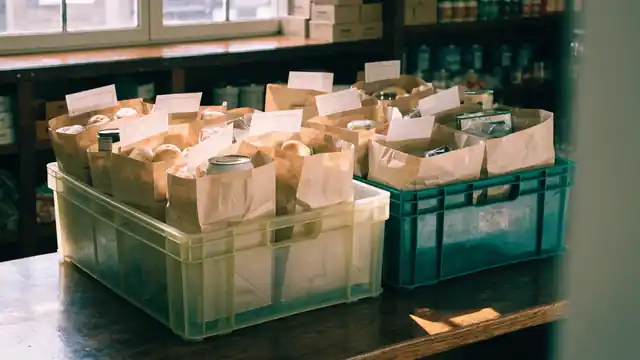
For a business customer, price often isn't the most important thing — reliability is: getting the packs on the agreed day, in the agreed number, all matching. If you do that well, the company orders from you again next year, and passes your name on inside the company too. It's worth writing a short offer in advance — three types, prices, deadline, collection — that you can send to local companies, offices and institutions in November.
How many to make in advance, and when
The biggest risk with gift packs is making too many in advance. A finished basket takes up space, the packaging has been used on it, and if it doesn't sell, it has to be taken apart. So don't put together all the season's packs at once, but in small batches, at the pace they sell.
| Period | What to do | How many to make |
|---|---|---|
| End of October | Choose the types and the products, order the packaging, write the business offer. | One sample pack per type, for photos. |
| Early to mid-November | Put out the sample packs, send the business offer, start taking pre-orders. | A few of each type — as many as might last a week. |
| End of November to mid-December | Take business orders up to the deadline, put them together during quiet hours. | Always keep enough ready-made packs for two or three days; top up based on how they sell. |
| Last week of December, up to the 23rd | Only make more of the types that sell well; no more custom combinations. | Smaller batches, adjusted daily. For the last two days, better too few. |
| After the holidays | Take apart what's left, or sell it on offer. | Don't make anything new. |
If you have no data from last year, start small: three to five ready-made packs per type, and watch which one sells. If a type sells out in two days, make more of it; if none has gone in a week, rethink its price or contents before making new ones. The safest is a pack you can take apart: made of products that are in your regular range anyway, and that can go from the basket back onto the shelf.
What to do with the leftovers
A few packs are almost always left over, and that's fine if you know in advance what you'll do with them. Ask the question while you're putting them together: if a third of these are left, what happens to them on 2 January? Where the answer is simple, you can be bolder; where there's no answer, you need a smaller batch and pre-orders.
| What's left | What to do | What to watch |
|---|---|---|
| A pack made of regular-range products | Take it apart and put the products back on the shelf. | Check the dates and put the older ones at the front. |
| A pack with festive-design products | Sell it at a sale price in the first days after the holidays. | By mid-January a Christmas design hardly appeals any more. |
| A pack in neutral wrapping | Reprice it and leave it out as a birthday or thank-you present. | Swap the festive ribbon and card for neutral ones. |
| Packaging | Keep it for next season. | Only the neutral pieces are worth keeping, somewhere dry. |
It's worth deciding and setting up the January offer in advance, so you don't have to come up with it on a tired morning after the holidays. A simple, clearly visible discount on the leftover festive packs — for example in the first week after the holidays — is usually enough to clear them. If the pack contains festive-design products, don't wait: the later you mark it down, the bigger the discount you need. How to set up an offer like this in advance, with an end date, is shown in Timed promotions: let the till ring the right price.
How to measure whether it paid off
At the end of the season it's worth answering three questions: how many packs sold of each type, how big the basket was on purchases with a pack compared with usual, and how much profit was left after packaging and labour. You don't need a complicated system for this, but you do need to see pack sales separately, so they don't get lost among all the other sales.
- Quantity by type. Which type sold well, which was left over? Next year you need more of the good seller, and less or none of the weak one.
- Basket size. How much did customers who bought a pack typically spend? If they bought something else with the pack, that's a bonus.
- Profit per pack and in total. The pack's price minus its cost, times the quantity — and take off whatever was lost on marked-down or dismantled packs.
- Comparing two periods. Putting this December next to last December or November shows whether the packs really brought in something extra, or just replaced the usual purchases.
- Business orders. How many companies ordered, in what quantity, and which ones order again? Next November, this list is your most valuable note.
Common mistakes
- The pack is cheaper than the products inside it bought separately. That way you give away the packaging and the work, and lose on every basket you sell.
- Too many types. Six to eight kinds of pack confuse the customer, and multiply the work and the leftovers.
- Products that need chilling or have a short date in a ready-made pack. Whatever stands by the counter for days has to cope with the warmth and the time.
- The contents and the price aren't written out. Someone who has to ask often just moves on.
- All the packs made in advance. If you put everything together at the start of the season, the leftovers are yours too — work in small batches, based on how they sell.
- Business orders agreed verbally, without a deposit. If the order falls through, the packaging, the products and the work are all left on your hands.
- Custom combinations on the busiest days. In the last days of December there's no time to build a custom basket for each customer; sell only the ready-made types then.
- No plan for the leftovers. If you decide on 2 January what to do with the leftover packs, it's already too late, and you need a bigger discount.
Summary
- A gift pack brings a bigger basket and a better margin, because the customer also pays for the ready-made solution and the wrapping.
- Three or four ready-made types, by price band, at fixed prices — custom combinations only as pre-orders.
- Long-life products that need no chilling, one "star" product and companions; take care with age-restricted products and with labelling the ingredients.
- The price: purchase price + packaging + labour + margin, and never cheaper than the products separately off the shelf.
- For business orders, an order form, a deposit and a deadline; make the packs in small batches, based on how they sell.
- Take apart the leftovers or sell them on offer after the holidays, and at the end of the season measure whether it paid off — compared with last year.
Frequently asked questions
Is it worth a small shop selling gift packs?
Usually yes, if you do it with a few well-thought-out types and the right pricing. The customer pays more for the ready-made solution and the wrapping than for the products separately, so the margin on the pack is better. On top of that the basket is bigger, and business orders can come from it too. It isn't worth it if the pack is cheaper than the products inside it bought separately, or if you make too many in advance and have to mark down the leftovers.
What should go in a gift basket?
Long-life products that need no chilling: good coffee or tea, honey, jam, special sweets, biscuits, oil, cordial. Have one "star" product as the centre of the pack, and two to four companions that go with it. If you have a local producer's speciality in your range, that's what really makes it personal. Cheese, cold meats, fresh cakes and dairy don't belong in a ready-made pack.
How do I work out the price of a gift pack?
Add up the purchase price of the products, the cost of the packaging — basket or box, cellophane, filling, ribbon, label — and the time it takes to put together. The margin goes on top. In the article's example, 60 units of purchases, 10 units of packaging and 5 units of labour give a cost of 75 units, so at a selling price of 115 units, 40 units, roughly 35 per cent, are left. The price should never be less than the products' shelf price plus the packaging.
Can the pack be cheaper than the products separately?
It isn't worth it, because then you give the packaging and your work away for free, and earn less than if you sold the products one by one. The customer doesn't expect a discount on a gift pack, but convenience and a nice finish. So the pack's price should rather be somewhat higher than the products' shelf prices together. You can give a quantity discount on business orders, but only out of the extra.
How many kinds of gift pack should I make?
In a small shop three or four ready-made types are enough: a small, a medium, a premium and, if there's demand, a business version. With more types the customer gets unsure, and you get more work and more leftovers. Build the types around price bands, because the customer typically arrives knowing how much they want to spend on a present. The middle one will sell the most, so give it the most attention.
Can I put alcohol in a gift pack?
In many places yes, but an age-restricted product is still age-restricted inside a pack. You can't sell it to a minor, and at collection the age has to be checked just as with an ordinary purchase. Local rules may contain further requirements on selling alcohol, so look them up. Always have an alcohol-free version too, and mark clearly on the pack if there's a drink inside.
Do I need to label the ingredients on a pack I put together myself?
Exactly what is compulsory to show varies from country to country, so local rules and your accountant can give you a precise answer. In practical terms it's worth doing anyway: once you seal the pack, the customer can't see the products' labels. Add a small card listing the contents, and mark the common allergens. This also matters to the recipient if they're sensitive to something.
How should I handle a corporate gift pack order?
Agree the type and the quantity, and fill in the order form with the name, contact details, unit price, total and collection time. For larger quantities ask for a deposit, and set a deadline, for example at least two weeks before collection. Put the packs together during quiet hours, and put a card with the customer's name on each. Issue the receipt or invoice with your existing till or invoicing solution, in line with local rules.
When should I start selling Christmas gift packs?
It's worth putting out the sample packs at the beginning of November, and sending the business offer then too. The types and the packaging are best decided and bought at the end of October. Until mid-December, make more in small batches based on how they sell, and in the last week only of the types that sell well. After 23 December, don't put anything new together.
How many packs should I make in advance?
If you have no data from last year, start with three to five per type, and watch which one sells. Always keep enough ready-made packs for two or three days, and top up based on how they sell. If a type doesn't sell even in a week, rethink its price or contents before making new ones. A pack you can take apart, made of regular-range products, is the smallest risk.
What should I do with leftover gift packs?
If they're made of regular-range products, take them apart and put the products back on the shelf, minding the dates. Sell festive-design packs at a sale price in the first days after the holidays, because in January they hardly appeal any more. Packs in neutral wrapping can be repriced and left out, without the festive ribbon, as birthday or thank-you presents. Keep the neutral packaging for next season.
How do I know whether the gift packs paid off?
Look at how many packs sold of each type, how much profit they left after packaging and labour, and how much was lost on marked-down or dismantled packs. Compare this December with last December to see whether the packs really brought in something extra. For that, the packs need to ring up at the counter as products of their own, in their own category. Also note which companies ordered, because next year they're your surest customers.
Say the product's name and it's there on the till.
Boltom App takes the work behind the counter off your hands. You find a product by looking at its photo or saying its name out loud — no codes, no scraps of paper. Whatever leaves the shelf or goes in the bin is recorded right there, not in a notebook. It works alongside your existing till, not instead of it.
- A quick code with a photo — or just say the product's name and the till finds it.
- Staff consumption in three taps, recorded under the person's name.
- Daily waste with its reason: expired, broken, unsellable — totalled up in money.
No card needed · 2 minutes