Most conversations about turnover start with the same sentence: there aren't enough customers. But turnover isn't one number — it is the product of three independent things. If you don't know which one is weak, even the best idea goes to the wrong place.
The three multipliers
| Multiplier | What it means | What it costs to move |
|---|---|---|
| Customer count | How many people come in and buy in a day | A lot — advertising, visibility, time |
| Average basket value | How much one customer spends per visit | Little — shelf, suggestion, range |
| Return frequency | How often the same customer comes back in a month | Moderate — habit and trust |
If basket value rises by ten percent, that is the same as ten percent more customers coming in — except you don't have to persuade anyone to come. So it is worth starting there, even when the feeling of shortage is about customer numbers.

1–4. Bring more people in
- 11. Put outside what you have insidePassers-by don't know what you sell. A board naming the fresh bakery, the coffee or the local produce brings more than any advertisement — and costs what the board costs.
- 22. Be visible before you openSomeone walking past at seven in the morning and seeing darkness won't look in during the afternoon either. A lit window and posted opening hours are the cheapest advertising there is.
- 33. Get onto the mapMost people searching on a phone look for a shop on a map. Accurate opening hours, a few recent photos of the shop, the real address — that's it. This step happens once and then works for years.
- 44. Ask the happy ones for a reviewNo campaign needed: someone who comes in regularly and says something kind can be asked to write it down. Five honest reviews are worth more than fifty paid placements.
5–8. Make the basket bigger
- 15. Put together what sells togetherButter next to bread, biscuits next to coffee, mustard next to sausages. Not a trick, a convenience: the customer remembers something they wouldn't have walked back for.
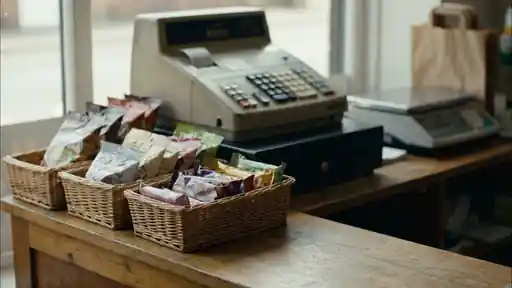
- 26. Keep something small at the counterThe area beside the till is the most expensive shelf in the shop. It doesn't want junk on it, but something a customer picks up while queuing — and doesn't regret afterwards.
- 37. Mention it before they payOne sentence: the scones are fresh, they just came in. Not a hard sell, just information. Once the team gets used to it, basket value shows it within weeks.
- 48. Have something to buy when the big ones are closedEvenings, Sundays, holidays — that is when people pay for convenience. Find the few products they come in for at those times, and never be out of them.
9–12. Make them come back more often
- 19. Have one thing they only get from youA bread, a cheese, your own baking, a local producer's goods. A single product like that gives a weekly reason to come in — which is why specialisation isn't narrowing, it is an anchor.
- 210. Learn their namesNo chain can copy this. A regular doesn't come back for the price, but because they count somewhere. It is the small shop's biggest advantage, and it is free.
- 311. Make fresh goods predictableIf they know the bakery arrives at seven in the morning and four in the afternoon, that is when they come. Predictability builds habit, and habit builds turnover.
- 412. Keep what you promiseOne promotion that doesn't happen, or posted hours you don't keep, does more damage than ten good days repair. Reliability is your slowest-building and fastest-collapsing asset.
What to measure, and what not to
None of these steps is worth anything if a month later you can't say which one worked. That doesn't need a spreadsheet, though — four numbers are enough, and all of them are in the daily close.
| What to look at | What it tells you | When to look |
|---|---|---|
| Daily turnover | The whole result — but it moves slowly | Weekly, comparing like days |
| Average basket value | The effect of steps 5–8 | Every two weeks |
| Daily transaction count | The effect of steps 1–4 | Weekly |
| Best-selling products | What works and what only sits on the shelf | Monthly |
What not to do
- Don't get into a price war with the discounter. Their price level comes from their volume, not their cleverness — that race can't be won.
- Don't start five things at once. If all five are running, you won't learn whether any of them worked.
- Don't discount your best seller. It would have sold anyway; the discount is pure loss.
- Don't widen the range without a system. A new product takes space from an existing one — and that one was selling.
- Don't measure a period shorter than two weeks. Daily fluctuation drowns out every real effect.
Ninety days, four numbers
- 1First week: write down the four numbers as they are NOW. Without that there is nothing to compare against.
- 2Days 1–30: work on basket value (steps 5–8). It is the fastest-moving multiplier.
- 3Days 31–60: work on visibility (steps 1–4). It takes longer to build, and lasts longer too.
- 4Days 61–90: work on return frequency (steps 9–12). This can't be rushed, but it is what stays.
- 5After day 90: look at the same four numbers. Where nothing moved, the step wasn't wrong — the multiplier you aimed at was.
In summary
Turnover isn't one immovable number but three multipliers you can work on separately. The cheapest and fastest is basket value: putting next to the customer already in the shop the thing they would buy anyway. Customer count moves more slowly and expensively, and return frequency builds over months — but that is what lasts longest.
The most important rule, though, isn't any one of the twelve steps: it is to change one thing at a time and leave it alone for two weeks. Without that the shop fills up with good ideas, and not one of them can be shown to have brought anything.
Frequently asked questions
Where should I start if there aren't enough customers?
It sounds odd, but with basket value. That multiplier moves fastest and cheapest, and the effect shows within two weeks. Bringing in new customers is slower and dearer — worth doing once you have got what there is out of the people already coming.
How long before results show?
Two weeks on basket value, four to six weeks on customer count, three months on return frequency. Over any shorter period, daily fluctuation drowns everything out.
Is it worth running promotions to grow turnover?
Only if you check the unit count afterwards. If the same number sold more cheaply, turnover rose while profit fell. A promotion is good when it brings a new customer, or moves stock that would otherwise become waste.
How do I measure customer count without till reports?
Daily transaction count is a good proxy: how many separate purchases happened in a day. It isn't perfect, but it shows the direction and can be compared week by week.
Should I bring in a new product group for the turnover?
Carefully. A new product takes space from an existing one that was selling. Start with five to ten lines, give them good shelf space, and after two months look at what it took and what it brought.
How much should I spend on marketing?
The first steps cost nothing: a board, the window, a map listing, reviews. Start there, because that is how you find out what people come in for at all — paid advertising will tell you the same thing, only more expensively.
What should I do if a bigger shop opens nearby?
You won't win on price, so don't compete there. Freshness, speed, opening hours and knowing people personally are ground where a chain structurally cannot follow you.
How many things should I change at once?
One. Two only if they affect completely different multipliers and you measure them separately. With five ideas started at once you are guaranteed not to know which one worked.
Say the product's name and it's there on the till.
Boltom App takes the work behind the counter off your hands. You find a product by looking at its photo or saying its name out loud — no codes, no scraps of paper. Whatever leaves the shelf or goes in the bin is recorded right there, not in a notebook. It works alongside your existing till, not instead of it.
- A quick code with a photo — or just say the product's name and the till finds it.
- Staff consumption in three taps, recorded under the person's name.
- Daily waste with its reason: expired, broken, unsellable — totalled up in money.
No card needed · 2 minutes