Most shopkeepers inherited their opening hours. Either from whoever they took the shop over from, or from the shop across the road, or from the fact that they started this way fifteen years ago and there was never a reason to touch it. That isn't wrong in itself — but it does mean the most expensive decision of the week has never been calculated by anyone.
And it is expensive. One hour of opening comes back every single day. Staying open an hour longer each day is over three hundred hours a year: more than a month and a half of full-time work. If that hour doesn't earn its keep, you are working a month and a half for free — or worse, at a loss, because the wage, the lights and the chiller run whether or not a single customer comes in.
And the opposite is just as true. For some shops that last hour is precisely what brings the regulars: the people who arrive after their shift and who would not come at any other time. There, closing doesn't save a cost, it hands a customer to the shop across the road. So there is no general answer to the question — but there is a calculation that answers it for your shop.

Why it is hard to get right
Opening hours are a special decision because, unlike every other decision in the shop, you cannot try it for a week and undo it. Order the wrong product and you mark it down and learn from it. Close an hour earlier, though, and the customer who came twice for nothing will not try a third time — and if you restore it six months later, they don't come straight back. A habit rebuilds far more slowly than it breaks.
The other difficulty is that quiet miscalibrates our senses. An empty hour feels endless behind the counter, a busy one flies past. If you go only by how it felt to be standing there, you will almost certainly underrate the quiet hour in which four regulars nevertheless came in and did a full shop — and overrate the busy one in which fifteen people each bought a soft drink.
There is a third trap too: opening hours are the one feature of your shop that a customer knows about EVEN IF they have never been in. It is on the door, it is on the map, and people in the area talk about it. So a change of hours is never only a question of cost — it is also a message about whether the shop is stable. That doesn't mean you shouldn't change them; it means it is worth changing them once, properly, and out loud, rather than monthly.
What an hour actually brings in
The commonest mistake is to look at the hour's TURNOVER. "We ring up fifteen thousand in the last hour, that's well worth it." Except that the wage isn't paid out of the fifteen thousand, only out of the part left above the cost price. If the last hour is mostly tobacco and phone top-ups, a few per cent of that stays with you. If it is fresh bread and dairy, considerably more. Two hours with identical turnover can give completely different results.
| What you look at | How you work it out | What it tells you |
|---|---|---|
| Turnover/hour | the amount rung up in the hour | Only raw activity — on its own it misleads |
| Margin/hour | for goods sold in the hour: (selling price − cost price), added up | The real result: this is what pays the wage and the electricity |
| Sales/hour | how many separate purchases took place | How many PEOPLE came in: one big basket does not make an hour |
| Basket value | turnover ÷ number of sales | What kind of shopping this is: a weekly shop or a quick stop |
| Cost of the hour | wage + contributions + estimated energy + your own time | The threshold the margin has to clear |
Many would cross out the "your own time" line on the grounds that it's free. It isn't. If you are the one standing there in the last hour, that hour costs what you could do with the same time instead: sleep, your family, or the ordering you otherwise do at eleven at night. You don't have to put a price on it, but it deserves a column on the paper — otherwise the calculation will keep telling you it is worth it, while you are the one being used up.

How to work out an hour's result
- 11. Pick the hours in questionDon't measure the whole day. It is usually two or three hours: the first hour after opening, the one or two before closing, and Sunday. Concentrate on those; the rest isn't in doubt anyway.
- 22. Collect two or three weeks, for the same time of dayOne week is too little, because a long weekend or a wet week carries the whole thing away. Over two or three weeks the swings average out. Note it down when something unusual happened that day — later that note will save the figure from being misread.
- 33. Write down turnover AND the number of salesTogether they mean something. If the hour's turnover is good but there were two sales, then the hour rests on two people — if one of them moves away, the hour ceases to exist. The count is the measure of stability.
- 44. Work out the margin, not the turnoverIf you don't keep records per product, estimate: look at what sells in those hours and use the shop's typical margin. Even a rough estimate beats using turnover, because turnover errs upward CONSISTENTLY.
- 55. Put the hour's cost beside itWage and contributions for that hour, plus the estimated extra lighting and refrigeration. If you are the one standing there, write in what it would cost to put someone else there — because if it doesn't pay with an employee, it doesn't pay with you either, the invoice is just invisible.
- 66. See what's left — and don't decide yetIf the margin is higher, the question is settled. If it is lower, still don't close: first comes the next section, filling the hour. Closing is the last resort, because it is the hardest thing to undo.
Before you close it: fill the hour
A weak hour isn't necessarily a bad hour — often it is just empty. Before you decide to end it, it is worth trying to give it a reason. That is a cheaper experiment than it sounds, because most of these moves cost no money, only reorganising.
- Move restocking and goods-in into that hour. If the quiet time is spent working anyway, the hour's cost isn't extra — you would have done that work at some point regardless.
- Move fresh stock to the end of the day. If the bread runs out at three in the afternoon, the evening customer comes for nothing. A smaller late delivery, or afternoon baking, can change the picture of the hour.
- Look at who comes in then, and ask them. "When could you come if not now?" A few sentences reveal whether the hour can be replaced, or whether these are precisely the people who would not come otherwise.
- Give it a reason that exists only then: bread fresh at the end of the day, taking tomorrow's orders, parcel collection — anything that works in that particular slot.
- Talk about it. If the neighbourhood doesn't know you are open until seven, they are already shopping elsewhere at six. The information on the door and on the map is worth more than any advertisement.
Give the experiment at least a month, then measure it the same way again. If the hour has moved, you have kept both your time and your customers. If it hasn't moved, you can close with a clear conscience: not because you gave up, but because you tried and measured.
Is it worth opening on Sunday?
Sunday is a separate question, because it is not about one hour but a whole day — and because the arithmetic differs. On Sundays the wage bill is higher in many places, supply is harder, but competition is thinner: precisely the shops that take your trade on weekdays are closed. Those two effects pull in opposite directions, so here it is even less possible to decide by feel.
| If this is your situation | Then Sunday is typically | What you need to check |
|---|---|---|
| Every larger shop nearby is closed | possibly the best-margin day of the week | Whether you have enough stock to last until Sunday evening |
| A larger store nearby is open | weak: customers go there for the big shop instead | What you can offer that still brings them in: fresh, near, fast |
| Holiday area or passing traffic | strong in season, dead outside it | Whether to open for the season and close outside it |
| Housing estate, working people | strong in the morning, quiet in the afternoon | Whether a shorter, morning-only Sunday is enough |
| You run the shop alone | exhausting for the owner, fast | How long you can keep it up — that is a cost too, even if nobody invoices it |
There is an important detail with Sunday that weekdays don't have: the half day. For many shops Sunday morning is worth it on its own while the afternoon is not. If that is what you find, you don't have to choose between "open" and "closed" — open for a shorter time. What matters is that the shorter time is PREDICTABLE, and that the same hours appear everywhere.

Early opening: who it pays for
Morning hours behave differently from evening ones. The customer of an early-opening shop is usually in a HURRY: on the way to work, and knows exactly what they want. That is both good news and bad. Good, because such a customer is reliable: once you are part of their route, they are there every morning. Bad, because their basket is small — coffee, a pastry, cigarettes, a paper — and if they are disappointed once, because you were closed or the bread had gone, they pick a different route immediately.
- The early hour works if there is a REASON to come: fresh bread, coffee, something already on the shelf at seven. With empty shelves, early opening is just an electricity bill.
- The early customer will not tolerate uncertainty. Find you closed twice and they are lost — they are far more sensitive to this than the afternoon customer.
- Look at where they come from: a bus stop, a works, a school. If there is nowhere nearby that people set out from in the morning, early opening will not fill itself.
- The early hour is the commonest place for the owner to burn out. If you open at six and close at eight, that is not a question of opening hours but of health.
- If the morning is strong and the evening weak, the best move is often not closing but SHIFTING: the same number of hours, pulled earlier.
Shifting is the most underrated solution. Most shopkeepers think in terms of "longer or shorter" hours, when usually it is not the NUMBER of hours that is wrong but where they sit. If the margin of the morning hour is double that of the evening one, then the same working hour produces twice as much — without anyone having to be persuaded of anything.
Whatever you change has to be written up
This is where most good decisions fall apart. The shopkeeper decides that from now on they close at seven, rewrites the sign on the door, and that's that. Meanwhile the Google listing says eight, the cover photo on the social page shows the year-before-last's hours, and the ad in the local paper a third version. From then on, somebody arrives for nothing every day — and in that customer's eyes it isn't the data that is wrong, it is the shop that is unreliable.
- The sign on the door — and not a handwritten note stuck over the old one. A slip of paper that looks temporary says this isn't final either.
- The Google business profile: the most important one, because that is where most people look. Holiday exceptions go in a separate field, in advance.
- Your social page's details and cover image — old hours on the cover mislead exactly as much as wrong data.
- If you have a parcel point or any partner service: it has to be changed there too, because the partner publishes your hours as well.
- The answering machine and anything else that announces times by itself.

Seasonal and temporary changes
Not every change has to be permanent. Seasonal opening hours are entirely legitimate — indeed, in a holiday area, next to a school or in a farming district they are the norm. The mistake is not the change but the unpredictability: if the customer cannot tell in advance which set applies, they will be unsure in both periods.
- 1Have two fixed modes, not ad-hoc days"Summer" and "winter" hours, with a definite switchover date. Moving between two clear states is understandable; following different times each day is not.
- 2Announce the switch at least two weeks aheadA date on the door ("from 15 September") is far better than different hours greeting the customer from one day to the next.
- 3Enter holidays separately, don't rewrite the normal hoursMap listings have a separate field for this. If you rewrite the normal hours for a holiday, nobody puts them back afterwards — this is the commonest source of wrong data.
- 4Measure again at the end of the seasonSeasonal hours age too. What was true three years ago may not be now: the bus timetable changed, a works closed or opened, the area shifted.
What never to do
- Don't decide on the basis of a single week. A wet week, a long weekend or an illness can kill any hour on paper.
- Don't close an hour on the basis of turnover. Turnover consistently makes the hour look better than it is — the margin tells the truth.
- Don't change monthly. Unpredictable hours take away more than any single hour ever brought in.
- Don't close "temporarily, we'll see". What starts as temporary never gets written up, and that is precisely what corrupts the data everywhere.
- Don't leave your own time out of the calculation. If you only count the wage bill and you are the one standing there, the sums will always say it's worth it.
- Don't let the shop next door decide for you. Their customers and their margins are different; your hours are set by your figures.
- Don't open longer just to "have an edge". An empty hour is not a competitive advantage, only fatigue.
Summary
- An hour pays when its margin covers the wage, the contributions, the energy and your own time.
- You need two or three weeks for the same time of day — and always write the number of sales beside the turnover.
- Before closing, spend a month trying to fill the hour: restocking, fresh stock, a reason that exists only then.
- Sunday can be a half day; shifting is often a better answer than shortening.
- Carry the change through everywhere within a day — the door, the map, the social page.
- Enter holiday exceptions separately, and never solve them by rewriting the normal hours.
Frequently asked questions
How long should I measure before deciding?
Two or three weeks for the same time of day. A single week is too little because one holiday, a wet spell or a school break rearranges it completely. If the picture is still unclear after three weeks, that is an answer in itself: that hour is erratic, so you cannot plan a wage bill around it.
I have no hourly breakdown. What do I do?
Paper and tally marks. During the hours in question, draw a line for every sale and write the amount beside it. Two weeks gives you exactly what you need, and no system has to be introduced. If you later do get an hourly breakdown, this step falls away.
How do I work out the margin if I don't record cost prices?
By estimate. Look at what typically sells in those hours and apply a typical margin percentage for that range. It is inaccurate, but inaccurate in the right direction — far closer to the truth than turnover, which always errs upward. In the longer run, recording cost prices pays for itself anyway, because without it the whole shop's result is guesswork.
Is it worth opening on Sunday?
It depends on your surroundings, and it has to be measured like any other hour. Typically it pays when the larger shops nearby are closed and you have enough stock to last until evening. If there is a larger shop open nearby, Sunday is rarely profitable — unless you offer something that brings people to you anyway. For many shops Sunday morning pays on its own while the afternoon does not: half a day is a perfectly good answer.
What if long hours are just a matter of local prestige?
Then it still has to be counted. Prestige does not pay the wage bill, and customers don't come back because you stay open late — they come back because when you are open, they find what they came for. A shop that is open for fewer hours but fully stocked and predictable is stronger than one open late, exhausted and with gaps on the shelves.
Will I lose my customers if I shorten the hours?
Some of them, yes — precisely those for whom that hour was the only option. That is why you must first see HOW MANY people are involved. If the last hour brings three or four sales a day and they are the same people, it is worth asking whether they can come at another time. Often it turns out they can — and sometimes that they can't. Both answers are usable.
What hours should I keep while I'm running the shop alone?
Your own capacity is a resource too, and the hardest to replace. Alone, long hours are not a business decision but a risk: if you go down, the shop stops. In that case shorter but sustainable hours often bring in more over a year than longer ones you can keep up for two months.
How should I handle public holidays?
Always as separately entered holiday hours, never by rewriting the normal ones. Map listings have a dedicated field for this and it can be filled in ahead of time. If you rewrite the normal hours, nobody puts them back — this is the commonest reason a shop shows the wrong hours for months.
What should I do if the shop next door stays open longer?
Don't copy them. Their margins, wage costs and customers are different. If you feel you are losing out, look at WHAT people buy there in that hour — and whether you could offer it at another time, better. Competition is rarely settled by longer hours; far more often by whether what they come for is on the shelf.
How much should I change at once?
One thing at a time. Either the closing time, or the opening, or Sunday — but not all three at once, or you will not know afterwards which change caused what. After a change, leave at least a month before touching the next one.
Is there an hour worth keeping open even at a loss?
There is. If that hour is the only slot your regulars can reach you in, then the hour's loss is really the price of the RELATIONSHIP — and those people bring it back on the other days of the week. But this has to be known, not assumed: you need to see whether the same people come back at other times too. If they don't, that hour really is just a loss.
Where should the opening hours appear so people actually see them?
On the front door, in the Google business profile, on your social page's details, and with every partner who publishes them (a parcel point, for example). Of the four, the map listing matters most, because most people check there before setting out — by then the sign on the door is only confirmation.
The hour shouldn't be decided by feel.
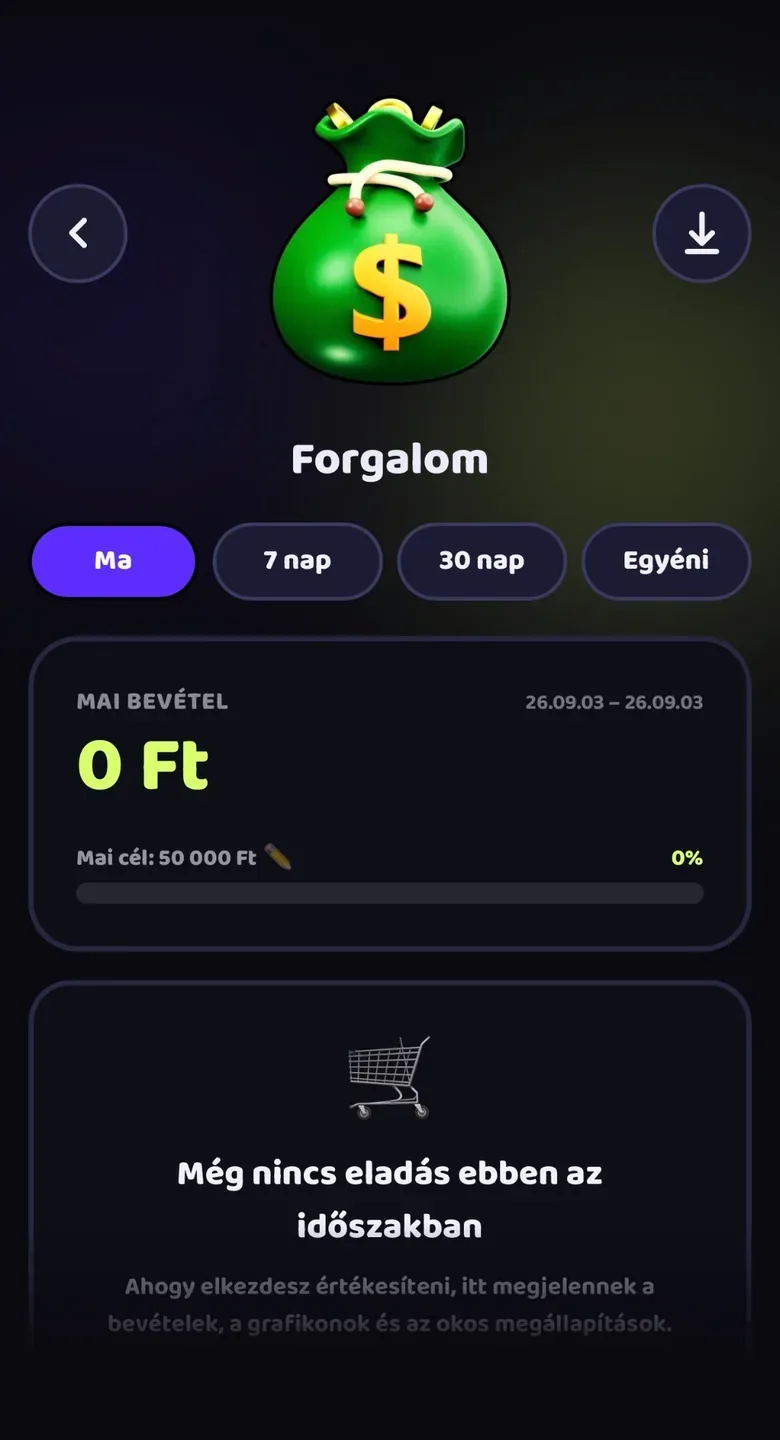
Boltom App's sales report breaks the day down by hour. After two weeks you can see which hour pays for itself, and which one only burns the lights.
- Hourly breakdown: how much came in each hour, and how many sales there were.
- Sales per product: what people buy in the last hour — and what they don't.
- If the connection drops, recording still works; it syncs by itself when you're back.
No card needed · 2 minutes