Why write it down?
While you are alone in the shop the routine lives in your head and works perfectly. The first day you are ill, it turns out that none of it is written anywhere. The problem isn't that your stand-in doesn't know it — it's that there is nothing for them to learn it from.
A written routine is not distrust. It's the opposite: it's what lets you leave without worrying, because the day is no longer held together by your memory.
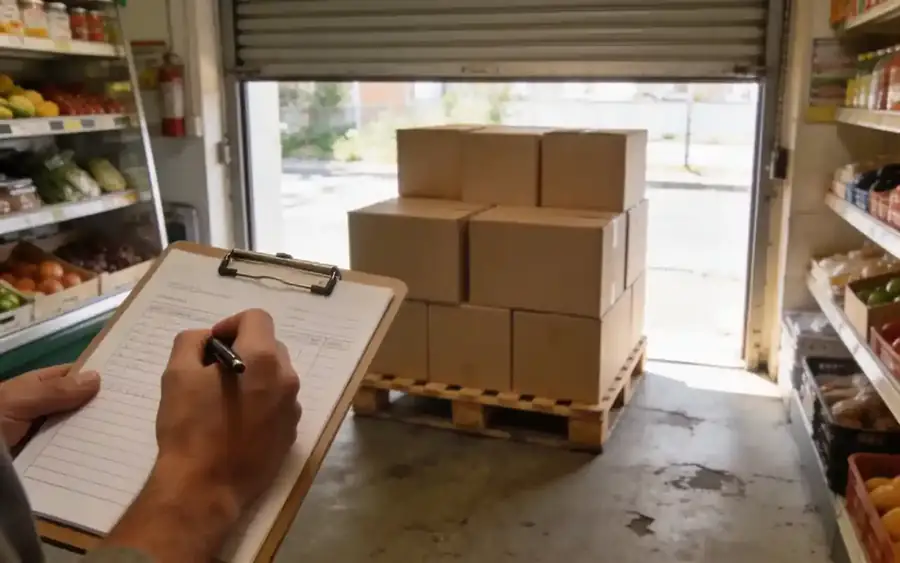
Opening: eight minutes
- 11. MoneyCount in the opening float and record it. This is the one step you can't skip: without it, nothing can be said about where the evening's difference came from.
- 22. Chillers and freezersTemperature at a glance. Not a log — just enough that if the power went off overnight you find out in the morning, not in the afternoon from a customer.
- 33. Fresh deliveriesWhatever arrived overnight or at dawn: out on the shelf, dates facing forward. Older stock in front, new stock behind — this step saves more waste than any other.
- 44. Surfaces and the doorwayWipe the counter, check the entrance and the window. A customer decides what kind of shop they are in within the first three seconds.
- 55. One lap of the shelvesNot restocking, just looking: what sold out last night, what is in the wrong place, where there is a gap. An empty shelf slot is the most expensive mistake you can spot in a minute in the morning.

During the day: three fixed points
The middle of the day can't be scheduled to the minute, because customers can't be scheduled. But there are three points worth fixing — all of them in the quiet hours.
| When? | What? | Why then? |
|---|---|---|
| After the morning peak | Restocking | This is when you can see what sold in the morning |
| Early afternoon | Dates and markdowns | There is still time to sell what would be waste tomorrow |
| Before the afternoon peak | An interim look at the till | If there is a difference, there is still someone to attach it to |
Closing: twelve minutes
- 1Record waste and markdowns — BEFORE you throw anything away. Afterwards nobody remembers how many there were.
- 2Close off staff consumption: whatever was taken from the shop that day goes in.
- 3Count the till and set aside tomorrow's opening float.
- 4Record the difference — even when it is zero. Zero is data too.
- 5Chillers, oven, lights, alarm.
- 6Tomorrow's first step: make space for whatever arrives at dawn.

Who does it, and when?
A routine works when every line has a name or a role against it. Not so that there is somebody to blame, but so that there is no step everybody assumes somebody else is doing.
| Step | Who? | What happens if it's skipped? |
|---|---|---|
| Opening float | The opening shift | The evening difference becomes meaningless |
| Dates facing forward | Whoever puts stock out | Waste rises, margin falls |
| Dates and markdowns | The afternoon shift | What could be marked down today is binned tomorrow |
| Recording waste | Whoever bins it | Reported profit ends up higher than the real one |
| Closing the till | The closing shift | The shortfall sticks to the whole day |
A list that actually works
- Short: five lines for opening, six for closing. Nobody reads a fifteen-line list past the second week.
- Where the work happens — behind the counter, on the chiller, on the stockroom door. Not in a folder.
- Every line starts with a verb: “count in”, “face up”, “record” — not “keep an eye on”.
- Nothing weekly on it. Weekly tasks belong on their own list.
- A colleague is allowed to rewrite it when something doesn't fit — a routine is a tool, not scripture.
What not to put on it
- Don't put on what everybody does anyway. It makes the list long, and long lists don't get read.
- Don't put monthly tasks on it. They belong elsewhere, or five lines will be irrelevant every single day.
- Don't put “be careful with” lines on it. They can't be ticked off, so they don't get done.
- Don't say the same thing twice in different words — that is how people learn the list isn't maintained.
- Don't put the penalty on it. A list that threatens isn't a list, it's a message.
In summary
- A daily routine is worth something because it is written down — the one in your head disappears on your first day off.
- Five steps to open, six to close, three fixed points in between.
- The opening float and the closing count are the backbone: without them a difference means nothing.
- Don't bin waste before recording it; afterwards it isn't data, only a memory.
- Give every line a role, or everyone waits for someone else.
- Keep the list short, active and where the work is.
Frequently asked questions
How long should opening take?
About eight minutes, in five steps: money, chillers, fresh deliveries, surfaces, one lap of the shelves. If it regularly takes longer, something that doesn't belong to opening has been added — usually cleaning or a weekly task.
Do I really have to count the float in the morning?
Yes, this is the one step of the routine you can't skip. Without an opening figure there is no way to tell whether the evening's difference came from the day or was already there in the morning — and the whole close loses its point.
When should I record waste?
Immediately before binning it. Afterwards nobody remembers the count, and estimated waste is worth as much as estimated turnover. If you bin without recording, your reported profit will be higher than the real one.
Where should I put the list?
Where the step happens: the opening list behind the counter, the chiller check on the chiller, goods-in on the stockroom door. A list in a folder gets read exactly as often as somebody opens the folder.
How do I introduce it without it feeling like surveillance?
Write it together with the person who does it, and start with closing — that one is more comfortable for everybody, because afterwards there is no argument about what happened. The first time a difference turns out to belong to a missing step rather than a person, the list becomes accepted on its own.
What about weekly tasks?
A separate list. If the weekly clean or the full date check goes on the daily list, then every day contains five lines that don't apply that day — and that is exactly how people stop reading it.
Can staff change it?
Yes, and that is a good sign. Somebody who reorders the steps because it is faster that way is using the list. A routine is a working tool, not a rulebook — the only thing to agree is that a change is shared with everyone, not just kept to themselves.
Say the product's name and it's there on the till.
Boltom App takes the work behind the counter off your hands. You find a product by looking at its photo or saying its name out loud — no codes, no scraps of paper. Whatever leaves the shelf or goes in the bin is recorded right there, not in a notebook. It works alongside your existing till, not instead of it.
- A quick code with a photo — or just say the product's name and the till finds it.
- Staff consumption in three taps, recorded under the person's name.
- Daily waste with its reason: expired, broken, unsellable — totalled up in money.
No card needed · 2 minutes