Why "when we get a minute" isn't enough
Cleaning is the job almost everyone considers important and almost nobody writes down. What happens in practice is that whatever is in plain sight always gets done — the counter, the floor by the door — and whatever isn't visible goes untouched for months. Not out of carelessness: it simply doesn't occur to anyone, because nothing is there to make it occur to them.
And there's a second, less comfortable effect. With no routine, cleaning always falls to whoever is least able to refuse — usually the newest colleague. That works in the short term; over time it breeds resentment, and the first tense moment reveals that the weekly jobs haven't been done for weeks.
The daily round: opening, during the day, close
What the daily jobs have in common is that they are short, and that none of them needs its own slot: they all fit into the opening, the quiet hours or the close. If any of them regularly takes more than ten minutes, you are almost certainly clearing up the remains of a weekly job that didn't happen.
- 1Before openingThe floor by the door and around the till, wiping the counter, the chiller doors and handles. Those are the three surfaces a customer touches before buying anything — and the ones their first impression comes from.
- 2During the day, in the quiet hoursAnything spilled, immediately — that isn't part of the close. Alongside that, wiping the counter, the scales and the card terminal, and the door glass if it's dirty. These are one- or two-minute jobs, which is exactly why they slip: there is never a moment when they are specifically due.
- 3After closingThe whole floor, bins out and re-lined, the counter cleared, the scales and the slicer cleaned if they were used. Fresh-food and deli equipment can't be left until morning — this is the point where cleaning is already food safety.
- 4What does NOT fit in the daily roundThe bottoms and backs of shelves, the inside of the chiller, the stockroom. They aren't left out because they don't matter, but because they don't fit into ten minutes — which is exactly why they need a day of their own.
The weekly and monthly lists
This is where it's decided whether the shop is actually clean or only clean at the front. What the weekly and monthly jobs have in common is that none of them is urgent — so if they have no day, they never come round.
| Job | How often | Why that often |
|---|---|---|
| Bottoms and backs of shelves | Weekly | Dust and dropped stock collect here — it's what the customer sees bending down |
| Inside of the chiller, shelf grilles | Weekly | Spilt milk or juice smells within a week, and takes the stock with it |
| Stockroom floor, bottom shelf row | Weekly | What you can't walk around, nobody checks |
| Washing out the bin | Weekly | Changing the liner isn't cleaning; the smell comes from the bin itself |
| Chiller back grille, condenser | Monthly | The dust layer costs more in electricity than it takes to wipe off |
| Vent grilles, light fittings | Monthly | Nobody ever looks up here, and the dust falls from here onto the goods |
| Tops of high shelves, top stockroom row | Monthly | Anything you have to climb to see won't get clean by itself |
The chiller is the most expensive place
Everywhere else, cleaning left undone means dirt. In the chiller it means stock. A spilled dairy product gives the whole shelf a smell within days, and nobody buys smelly stock — regardless of whether it's in date. This is the point where cleaning and waste are two sides of the same question.

- Emptying and washing out the chiller is a weekly job. Do it before opening or after closing, not at the busy hour.
- Clean up spillage at once — it can't wait for the weekly round, because it dries on within a day.
- The chiller's back grille and condenser are a monthly job: the dust layer hurts efficiency, so it costs electricity too.
- Look at the door seal as well: a damaged or mouldy gasket is a hygiene and an energy question at once.
- The handle and the door glass are the most-touched surfaces in the shop — but those are a DAILY job.
- Checking the temperature isn't cleaning, but it belongs to the same round: if you have a thermometer, look at it every day.
What never to do
- Don't store cleaning products next to the goods. Separate place, labelled — this is the mistake an inspection spots immediately.
- Don't use the same cloth for the counter and the floor. Separate them by colour, so nobody has to remember.
- Don't leave the deli equipment until tomorrow. The slicer and the scales are clean at the end of the day, not next morning.
- Don't put cardboard boxes straight on the stockroom floor. It isn't only hygiene: what you can't walk around, nobody inspects.
- Don't leave cleaning to the same one person on the grounds that they're the newest. That's the omission that goes off all at once, months later.
- Don't write a list that can't be worked through in ten minutes. An over-long list behaves exactly as if it didn't exist.
In summary
- Three separate lists are needed: daily, weekly, monthly. A merged list belongs to nobody.
- The daily round fits into the opening, the quiet hours and the close — if it doesn't, a weekly job was missed.
- The weekly and monthly jobs need a fixed day and a specific name, not a role.
- The chiller is where cleaning left undone means unsellable stock rather than dirt.
- What isn't visible — the backs of shelves, the bottom stockroom row, the vent grille — has to go on the list explicitly.
- Cleaning products and equipment belong in a separate, labelled place, away from the goods.
Frequently asked questions
How much time does all this take daily?
The daily round is twenty to thirty minutes in total, split three ways: a few minutes before opening, one or two in the quiet spells, and the rest after closing. If it regularly feels like much more, it almost certainly means the weekly jobs were missed and you're clearing up their remains in the daily round.
Who does the weekly round if there are several of us?
Give it a name, not a role. The daily jobs can be assigned to "whoever opens" and "whoever closes", because they come round every day and it shows when they're skipped. With a weekly job, a role means everyone assumes somebody else did it. One name and one fixed day — that's the difference between it happening and not.
Do I have to keep a written cleaning record?
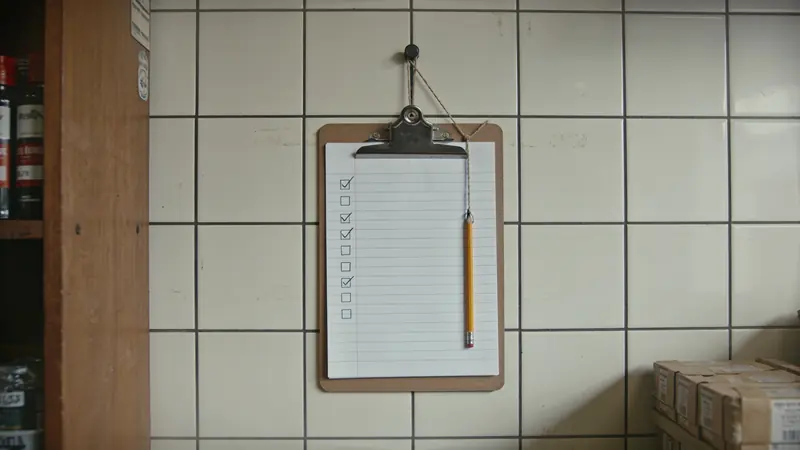
That's regulated differently by country and business type, so the local rules are what matter. What is true regardless of regulation: a written list pays for itself anyway, because only that keeps track of the rare jobs. An A4 sheet on the back-room wall with tickable lines is enough for every practical purpose.
What should I clean with?
Near food, with something intended for it, at the dilution and contact time given on the pack. The common mistake isn't the wrong product but the wrong use: too strong a solution, wiping off before the contact time, or one cloth for everything. It's worth separating cloths by colour — then nobody has to remember which goes where.
What if something spills in the chiller?
Clean it at once, don't wait for the weekly round. In a chiller every liquid dries on, and within days gives the whole shelf a smell — and nobody buys smelly stock, even when it's perfectly good. This is the moment when five minutes of cleaning saves more stock than a week's waste.
When should I clean the stockroom?
Weekly, on the same day as the backs of the shelves. The stockroom is dangerous precisely because customers never see it, so nothing forces the issue. The basic rule is that you should be able to walk around everything: what you can't get behind, nobody checks — neither for cleanliness nor for dates.
What does an inspection look at?
The exact criteria differ by country and business type, so the local rules govern. In practice, though, nearly everywhere the same few things come up: chiller temperature, cleaning products stored separately, the cleanliness of deli equipment, how dates are handled, and whether stock is standing on the stockroom floor. That list does no harm to have in order anyway.
Say the product's name and it's there on the till.
Boltom App takes the work behind the counter off your hands. You find a product by looking at its photo or saying its name out loud — no codes, no scraps of paper. Whatever leaves the shelf or goes in the bin is recorded right there, not in a notebook. It works alongside your existing till, not instead of it.
- A quick code with a photo — or just say the product's name and the till finds it.
- Staff consumption in three taps, recorded under the person's name.
- Daily waste with its reason: expired, broken, unsellable — totalled up in money.
No card needed · 2 minutes