The two dates are not the same
Food can carry two kinds of date, and this is not a matter of wording: there is different logic behind each. The use-by date appears on products that spoil quickly and carry a microbiological risk — fresh meat, fresh fish, some dairy. It is a safety limit. The best-before date, by contrast, tells you how long the product keeps its characteristic qualities: taste, texture, colour.
| Use-by date | Best-before date | |
|---|---|---|
| Wording | "Use by …" | "Best before …" |
| What it covers | Food safety | Quality and sensory properties |
| Typical products | Fresh meat, fish, some dairy | Dry pasta, tinned goods, flour, coffee |
| After the date | In the EU it is deemed unsafe | Not automatically spoiled — but rules differ |
| What the shop does | It must leave the shelf before the date | Separate and label according to local rules |
Rotation is part of restocking
Most waste in a shop isn't caused by bad ordering, but by new stock going in front of the old. This doesn't happen out of carelessness: when you're restocking, the crate is in your hands, the front of the shelf is empty, and the quickest movement is to put it there. Pulling the existing stock out first takes two seconds longer.

- When restocking, always pull the existing stock forward and put the new behind it — never the other way round, and never on a "I'll sort it later" basis.
- If the shelf is deep, you have to be able to reach the back row. Where you can't reach behind, rotation stays theoretical.
- The same rule applies in the chiller, only it matters more: the shorter dates there mean trouble arrives faster.
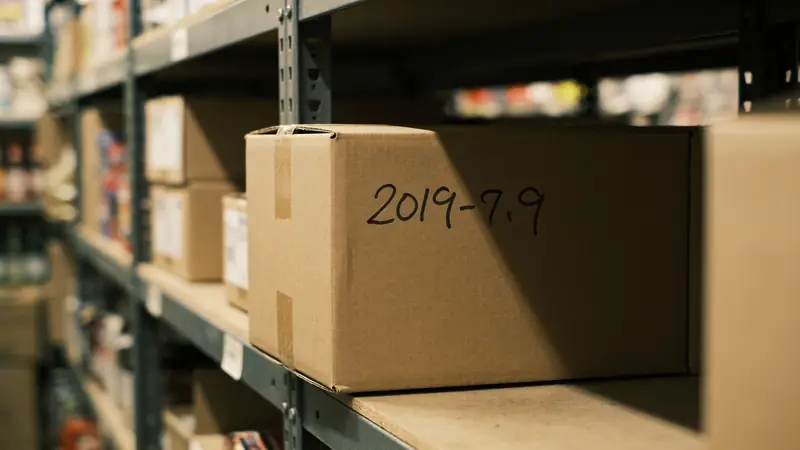
- Rotate in the stockroom too: a box put on a back shelf expires just the same, only nobody sees it.
- Don't mix batches of the same product with different dates in one row — then nobody can tell which is older.
- If a new colleague is restocking, show them this one movement first. It's the rule that pays back the most.
The weekly round: what expires within a fortnight
Rotation prevents, but it can't see into the future. To have time to act, you need a regular check whose output is a list — not a feeling, but specific products with specific dates.
- 11. Give it a fixed dayAlways the same day, ideally one of the quieter ones. The date matters more than the good intention: a job with no day always slips to next week.
- 22. Walk everything, not just what's in front of youFront of shelf, back of shelf, chiller, freezer, stockroom. A significant share of waste comes from exactly where the daily routine doesn't look.
- 33. Write down what expires within ten to fourteen daysProduct, date, quantity. Those three are enough. Ten to fourteen days is a good window because there's still time to sell, but it's already clear it won't go on its own.
- 44. Decide line by lineThere are three options: leave it (it'll sell), mark it down, or give it a prominent spot. The fourth — "I'll keep an eye on it" — isn't a decision, and in practice that's where the waste comes from.
- 55. The following week, see what happened to themIf a product comes back onto the list week after week, rotation isn't at fault — you're ordering too much of it. So the list doesn't just rescue stock, it teaches you something.
Where most of the dates run out
When someone walks a shop with the weekly round, expiring stock isn't spread evenly. It gathers in a few identifiable places — and almost everywhere they're the same ones. It's worth knowing them by name, because it makes the round quicker too.
- The back of the shelf: where rotation was skipped, the oldest batch piles up.
- The bottom and top rows of the chiller: neither the customer nor the staff really look into these.
- The high stockroom shelf: once something goes up there, it stays until somebody deliberately takes it down.
- Rarely requested but stocked lines: these turn over so slowly that the date gets there first.
- Multi-size products: the large pack moves more slowly, yet carries the same date.
- Leftovers after a promotion: normal sales won't clear a promotional quantity.
A markdown needs time
The commonest mistake isn't the absence of markdowns, it's that they come too late. If a product goes on offer on the day it expires, the customer has to buy it and use it that same day — and few will take that on. A few days earlier, the same product sells at the same price.
- Use a fixed marking: the same sticker or label every time, so customers recognise it.
- Use a fixed place: a shelf end or a basket where short-dated stock can always be found.
- Let the marking state the reason too. "Short date" is honest, and it doesn't put customers off — it earns trust.
- Don't start on the day of expiry. Give it as many days as an average customer needs to use it up.
- If the markdown didn't work either, write that down too: that's how you learn the price wasn't the problem.
- Anything past its date should leave the shelf immediately, not at the next round — expired stock on the shelf is the most expensive kind of oversight.
What not to do
- Never alter or cover the manufacturer's date marking. This isn't a grey area — it's the line where both trust and the rules sit.
- Don't push short-dated stock to the back "so it isn't noticed". It works the other way round: what isn't seen isn't bought.
- Don't leave rotation to whoever happens to have time. Make it part of restocking, for everyone, always.
- Don't keep a separate date notebook if the weekly round already covers everything — a parallel record goes out of date sooner or later, and from then on it misleads you.
- Don't discount things that would sell anyway. A markdown manages risk; it isn't a way to grow turnover.
In summary
- A use-by date is a safety limit, a best-before date is a quality marker — what you do about them differs.
- Rotation isn't extra work, it's part of restocking: old forward, new behind, every single time.
- Once a week, on a fixed day, write down what expires within ten to fourteen days — shelf, chiller, stockroom.
- Every line on that list needs a decision: leave it, mark it down, or give it a prominent spot.
- A markdown needs time — on the day of expiry it's already too late.
- Whatever returns to the list week after week is an ordering question: order less of it.
Frequently asked questions
What is the difference between a use-by and a best-before date?
A use-by date appears on quickly perishable products carrying a microbiological risk, and it is a safety limit: under EU rules food is deemed unsafe after it. A best-before date tells you how long the product keeps its characteristic quality — that is a quality category, not a safety one. The most important consequence in the shop is that stock of the first type must leave the shelf before the date, while for the second, local rules decide what you may do.
Can I sell after the best-before date?
This is regulated differently from country to country, so there is no single valid answer. In several EU member states it is possible under defined conditions — separation, clear labelling, certain product groups excluded — and elsewhere it is not. Before adopting any practice, check the rules that apply where you are; this article is about organising work, not legal advice.
What does FIFO mean in a shop?
That whatever arrived first goes out first — first in, first out. In practice it is a single movement: when restocking, you pull the existing stock forward and put the new behind it. Importantly, it isn't the arrival order that decides but the date: if a batch that arrived later carries an earlier date, that one goes in front.
How often should I check dates?
Fast-moving stock on the shelf daily, while restocking — that isn't a separate job. The full check, covering the back of the shelf and the stockroom, is enough once a week, but it needs a fixed day. The daily and the weekly round don't replace each other: the daily one catches what expires tomorrow, the weekly one what expires in a fortnight.
How many days before the date should I mark down?
There is no universal number, because it depends on the product: a yoghurt is not a long-life milk. The useful test is whether the customer has enough time to use it up in normal use. If not, you're not offering a discount, you're offering a problem — and next time that customer won't go near the markdown shelf.
What should I do about something that expires regularly?
Reduce the quantity you order, don't deepen the markdown. If a product appears on the short-date list week after week, the problem is on the buying side: you're bringing in more than sells. Change one product at a time and watch it for two weeks — that's how you find the quantity that still clears.
Who is responsible for dates if several of us work here?
Everyone who restocks is responsible for the daily rotation — that can't be divided up, because it either happens at each restock or it doesn't. The weekly check, though, needs a name rather than a role: with jobs that recur rarely, a role means three people each assume somebody else did it.
Say the product's name and it's there on the till.
Boltom App takes the work behind the counter off your hands. You find a product by looking at its photo or saying its name out loud — no codes, no scraps of paper. Whatever leaves the shelf or goes in the bin is recorded right there, not in a notebook. It works alongside your existing till, not instead of it.
- A quick code with a photo — or just say the product's name and the till finds it.
- Staff consumption in three taps, recorded under the person's name.
- Daily waste with its reason: expired, broken, unsellable — totalled up in money.
No card needed · 2 minutes