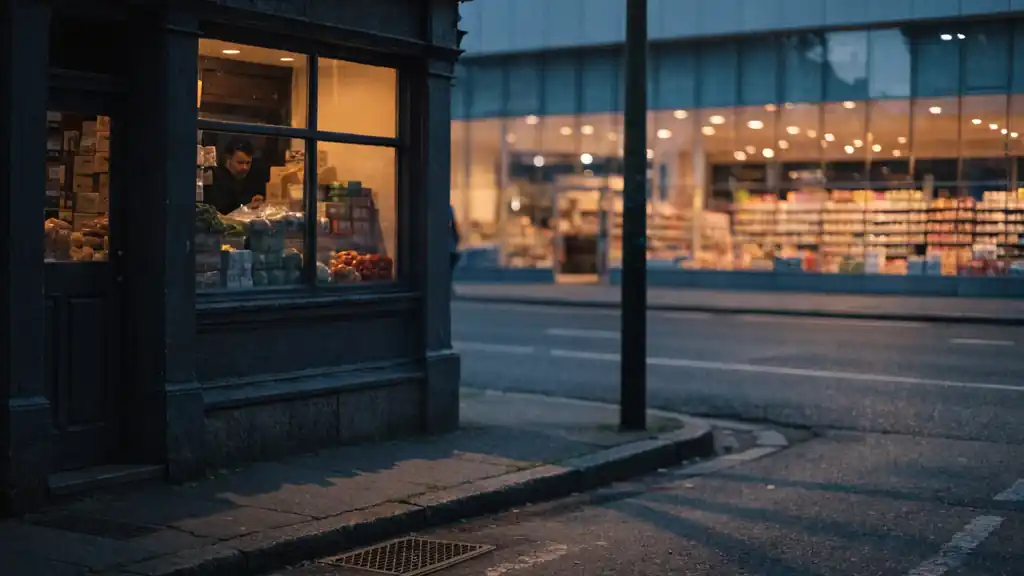
The news usually arrives weeks before the opening: people in the area say something is being built, then the sign goes up. And from that moment one question runs in the shopkeeper's head: how much is this going to take. The worry is justified, but the first reaction is almost always the wrong one — and that is precisely the decision that is hardest to undo later.
The most common first reaction is to cut prices. It is understandable, and entirely futile. A large chain can be cheaper because it buys on an altogether different scale, has its own label manufactured, and built its logistics around its own size. Its SELLING price on a whole run of products is lower than your BUYING price. Entering that contest means paying, on every unit sold, for the privilege of the customer shopping with you.
The good news is that this isn't where it is decided. A small shop doesn't live on being cheaper; it lives on being closer, faster, and on knowing its customers. This article is about turning that into numbers: which trade actually leaves, which stays, what is worth doing in the first month, and what must be avoided.

What actually happens in the first months
Trade doesn't fall evenly; it follows a characteristic curve. It is worth knowing this in advance, because the low point is not the end state — many shops make a decision in their worst week that they regret later.
| Period | What happens? | What it feels like | What to do |
|---|---|---|---|
| Opening week | Everyone goes to look, at opening-offer prices | An empty shop, alarming days | Nothing. This is curiosity, not a decision. |
| Weeks 1–4 | The weekly shop starts to move across | Trade is visibly lower | Measure: which lines fell and which didn't |
| Months 2–3 | Typically the low point; the novelty wears off | This is the hardest stretch | Don't make a final decision in panic |
| Months 4–6 | Urgent and top-up shopping finds its way back | The numbers settle | Now rebuild the range, on the data |
The most important thing here: the figures from the fourth month are worth more than those from the second. If you rebuild the range at the low point, you are optimising for a situation that won't last — and you will take out exactly what would have brought the customer back later.
Why the price war cannot be won
It is worth working this through once, because afterwards the question never comes up again. A large chain's buying price is lower because it thinks in lorries rather than pallets, and because it brings its own-label goods straight from the manufacturer. The difference isn't a few per cent; it is often double figures.
| Item | Large chain | Small shop | What it means |
|---|---|---|---|
| Purchase volume | National, lorry-load quantities | A few cases a week | You are on different price lists, not the same one |
| Own label | Made to order, no middleman | Not an option | Their bottom price level cannot be followed |
| Logistics | Own warehouse and fleet | Wholesaler or supplier delivery | Delivery cost is built into your price |
| Loss leaders | Can afford a deliberately loss-making line | Every line has to earn | Their offer price may be bait; yours cannot be |
There is one exception worth knowing: the handful of visible "signal prices". Customers typically judge on five to ten products — bread, milk, sugar, a drink — and form their view of whether a shop is expensive from those. On those few it is worth staying close. Across the whole range it is pointless, because the customer isn't comparing them anyway, while you are giving away your margin.

Which trade leaves, and which stays
Shopping isn't one single thing. The same person does a big shop once a week, and alongside that comes in five times for something. These two behave completely differently when a large store opens nearby.
| Type of purchase | What happens to it? | Why? | What to do about it |
|---|---|---|---|
| The weekly big shop | Mostly leaves | They drive; price and range decide | Don't fight for this; fill its place with something else |
| An urgent, missing item | Stays, and may even grow | Two minutes on foot vs. twenty by car | This must always be available, never out of stock |
| Daily fresh goods | Mostly stays | Freshness and small quantities matter | Build on this: order daily, order little |
| Morning and on-the-way purchases | Stays | Timing: the big store is still closed | Opening hours and coffee/bakery belong here |
| Elderly and less mobile customers | Stays, and is loyal | The distance is a real obstacle | Delivery, small quantities, a helping hand |
If you check this table against your own shop in the report, you will see how true it is for you. In some shops the daily range was eighty per cent of turnover to begin with — a shop like that loses far less than it fears. In others the weekly shop was the main leg; there the rebuild is real work, and the sooner it starts the better.
What the big store cannot do — and you can
- Closeness. Two minutes on foot cannot be substituted by anything. It is the one advantage you have that money cannot buy — and everything else follows from it.
- Speed. In and paid and out in three minutes. In the big store the queue costs more than that, even if the product is cheaper.
- Small quantities. One sausage, two eggs, half a kilo of potatoes. The chain cannot sell like this, because its system isn't built for it.
- Daily freshness. If your bakery arrives in the morning and sells out by the afternoon, that is a quality central logistics cannot deliver.
- Opening hours. Early morning, late evening, Sunday, a public holiday — where the big store is closed, there is no competition.
- Familiarity. You know what someone usually buys, you can put things aside, you can give credit to someone you know. That isn't sentiment; it is a real commercial advantage.
- Local produce. What is made nearby, the chain typically doesn't list. That is a range people come to you for specifically.
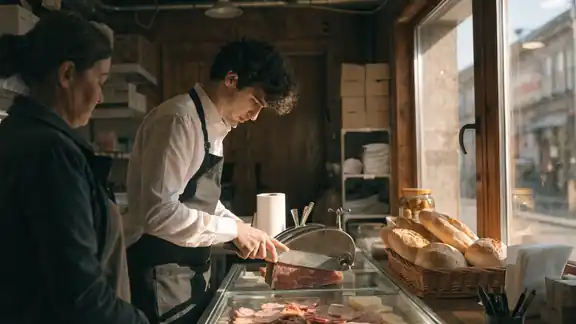
What to do in the first month — in six steps
- 11. Record the starting positionBEFORE the opening, write down your daily turnover and how it splits by category. Without that you won't be able to say later what fell and what didn't — you will only feel that things are worse.
- 22. Change nothing for the first two weeksThe opening week's figures mean nothing. Everyone goes to look. Anyone who starts discounting now is giving away their margin to a wave that will pass by itself.
- 33. See which lines fellAfter a month, compare the categories with the earlier period. It isn't total turnover that matters but its structure: typically the long-life, large-pack goods fall while fresh and daily lines hold.
- 44. Set your signal pricesPick the five to ten products customers judge your price level on, and stay close on those. Leave the rest alone — there, cutting prices brings no customers, only takes margin.
- 55. Build what they cannot doOpening hours at the edges, daily fresh goods, small quantities, local produce, delivery for elderly customers. Introduce one at a time, and measure each for two or three weeks.
- 66. Run down the slow stockWith falling trade, stock turns more slowly and your money stands on the shelf. What hasn't moved for two months has to be cleared now — not when there is nothing left to order with.
„A small shop doesn't live on being cheaper. It lives on being closer, faster, and on knowing who walks through the door.”
Rebuilding the range: what to drop, what to add
This is the part that really counts, and the one that takes the most work. The principle is simple: don't stock what the big store is stronger at, and do stock what you are stronger at. Shelf space is finite, so every decision is a swap.
| Narrow this | Why? | Widen this | Why? |
|---|---|---|---|
| Large-pack long-life goods | This is exactly why they go to the big store | Small packs, single-item purchases | The chain cannot serve this |
| Deep brand choice in one category | Five versions of the same thing turn slowly | Daily fresh goods, bakery, dairy | Gives freshness and closeness |
| Non-food long-life items | Bought rarely, stands for a long time | Local producers' goods | Not available elsewhere; they come to you for it |
| Seasonal decorations and gifts | High margin, very slow turn | Ready food, coffee, on-the-way items | Bought for timing and convenience |
One thing must not be dropped even if it sells slowly: the handful of staples people come in for. If someone walks in because they can buy bread and there isn't any, it isn't only the bread that is lost but the other three items they would have picked up — and next time they won't set off at all.
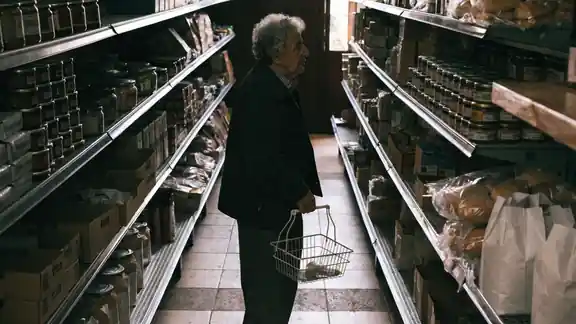
What not to do
- Don't enter a price war across the whole range. It cannot be won mathematically, and every unit sold makes your position worse.
- Don't make a final decision in the second month. That is the low point, and from there everything looks worse than it will lastingly be.
- Don't shorten your opening hours first. Those few edge hours are precisely the ground where you have no competition.
- Don't drop fresh goods because they are risky. Freshness is one of the very reasons people come in at all.
- Don't speak ill of the new store to customers. People will shop there too; disapproval only makes you unpleasant.
- Don't order the same quantities as before. With falling trade, the old order size means expiring stock and tied-up money.
- Don't start a large investment in the first six months. Until you know where trade settles, every big outlay is flying blind.
Summary
- Don't take up the price war: your buying price is higher than their selling price.
- Trade leaves piece by piece — the weekly shop goes, the daily range doesn't.
- The low point is months 2–3; the lasting picture shows in months 4–6.
- Stay close on five to ten signal products; don't sacrifice your margin on the rest.
- Build on what the chain cannot do: closeness, speed, freshness, small packs, opening hours.
- With falling trade, slow stock has to be run down sooner, not later.
Frequently asked questions
Frequently asked questions
How much trade will I lose if a discounter opens nearby?
There is no general figure, because it depends on how your trade was made up. If most of your takings came from the weekly big shop, you will lose a lot; if daily, urgent and fresh purchases made it up, considerably less. That is why it matters to record the split by category before the opening: from that you can see your exposure in advance, rather than judging the situation by your worst week.
Should I cut my prices?
Not across the whole range. Your buying price is often higher than the chain's selling price, so in that contest you lose on every unit sold. What is worth doing: pick five to ten products customers judge your price level on — typically bread, milk, sugar, a popular drink — and stay close on those. On the other two hundred lines, cutting prices brings no customers and only takes your margin.
How long until trade recovers?
Trade typically doesn't return to its old level but settles at a lower, stable one — generally within four to six months. The low point is in the second or third month, and some of it comes back after that as the novelty fades and customers experience the twenty-minute queue in the big store. That is the period in which it matters most not to make a hasty decision.
What should I do about opening hours?
Don't shorten them first, because at the edges you have no competition. If the big store opens at eight and closes at eight, then the morning between seven and eight, the late evening, Sunday and public holidays are yours. It is worth looking at when trade actually happens, though: if two hours in the afternoon are consistently empty, those can be shifted to the morning or evening edge — the same wage hours, more customers.
Should I stock the same products they do?
Partly. The staples must always be there, because that is what people come in for — bread, milk, cold cuts, a few drinks. But it is pointless keeping deep brand choice in the same category: five kinds of washing powder turn slowly, and that is exactly the range people buy on the big shop anyway. The right direction is to keep the staple range while widening towards what they cannot do.
Do promotions help?
General, continuous discounting doesn't, because the chain can always undercut it. What works is a timed, short promotion on something that suits you: daily fresh goods at an afternoon price, a local producer's line at an introductory price, ready food at lunchtime. Their purpose isn't to be cheaper than the big store but to give a reason to drop in at a particular time of day.
What should I do with stock if trade falls?
The most important and most frequently missed step: reduce your order quantities, and run down slow stock while it can still be sold. At lower turnover the old ordering rhythm means stock close to its date and money standing on the shelf — exactly when you can least afford it. Lines that haven't moved for two months have to be cleared now, not in six months' time.
Is it worth starting a delivery service because of this?
If you have customers who find it hard to reach the shop — elderly or less mobile people — then yes, because that group is particularly loyal and the big store cannot reach them because of the distance. Start with the cheapest form: phone orders, collection from the shop, or a round on one fixed day. It isn't worth building a big system until you can see how many people use it.
What should I say to customers about the new store?
As little as possible, and nothing bad. Your customers will shop there too, and if they sense the shopkeeper's disapproval, it makes them uncomfortable, not the chain. Instead, it is worth saying what you offer: that you are open at seven in the morning, that the bread comes mid-morning, that you will put things aside. That isn't competing; it is a reminder.
Is there any point selling local produce?
In many cases this is one of the strongest moves, because chains typically don't list small producers. Honey, cheese, eggs or jam from nearby is a range people come to you for specifically, and one that cannot be compared on price. Watch two things: have the paperwork and traceability in order, and try a small quantity first, because not every local product sells.
When should I start thinking about closing?
When, after things have settled — so beyond the sixth month — trade persistently fails to cover the fixed costs, and running down the stock doesn't get money out of it either. It is worth writing this down in advance: below what figure, for how many months. We make this decision badly in a panic, but soundly when it is stated beforehand. In some cases the answer isn't closing but radically reshaping the opening hours and the range — though that too needs numbers.
What should I do if customers say I'm more expensive?
Don't get defensive and don't explain the price. Ask which product they mean — usually two or three specific lines are what come up. Look at those seriously, and bring them closer if you can. For the rest, say the truth calmly: you buy in smaller quantities, so your price is higher; in return you are here on the corner, open at seven, and fresh. That sentence works, because it is true.
Which of your lines held? The report will tell you.
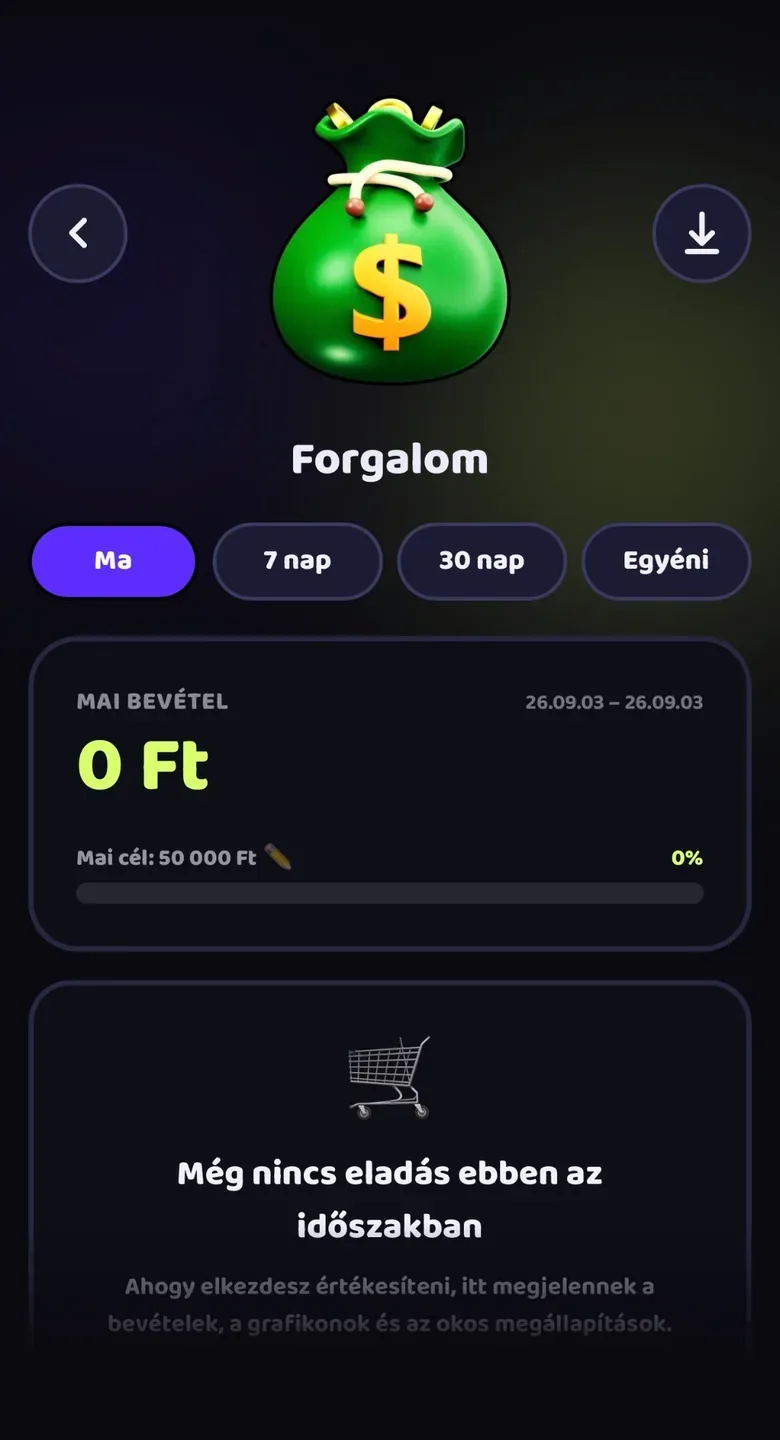
In Boltom App you see turnover and profit by product and by category. The same view before and after the opening — so you aren't deciding what to keep on a hunch.
- Turnover AND profit per product — you see what stayed and what left.
- A breakdown by category: the daily range apart from the weekly shop.
- Two periods side by side: the month before the opening and now.
No card needed · 2 minutes