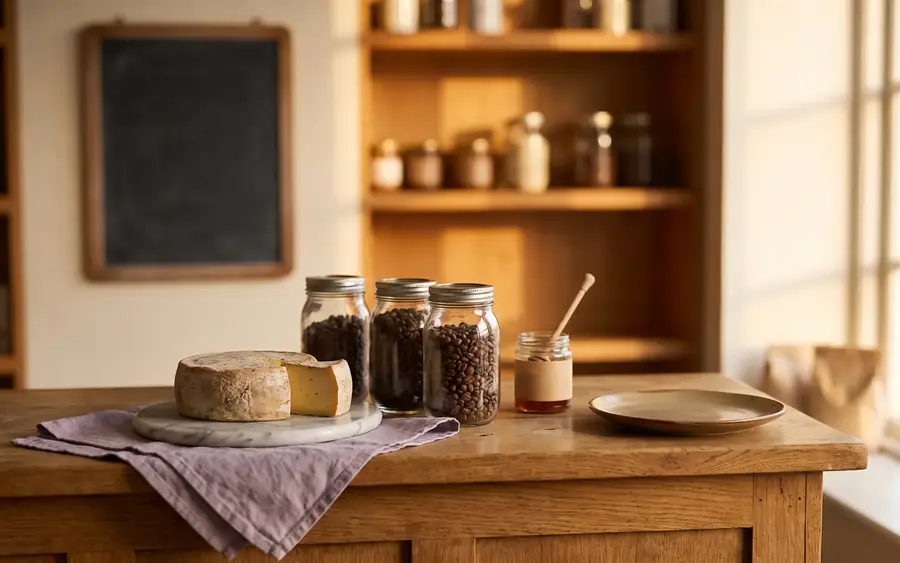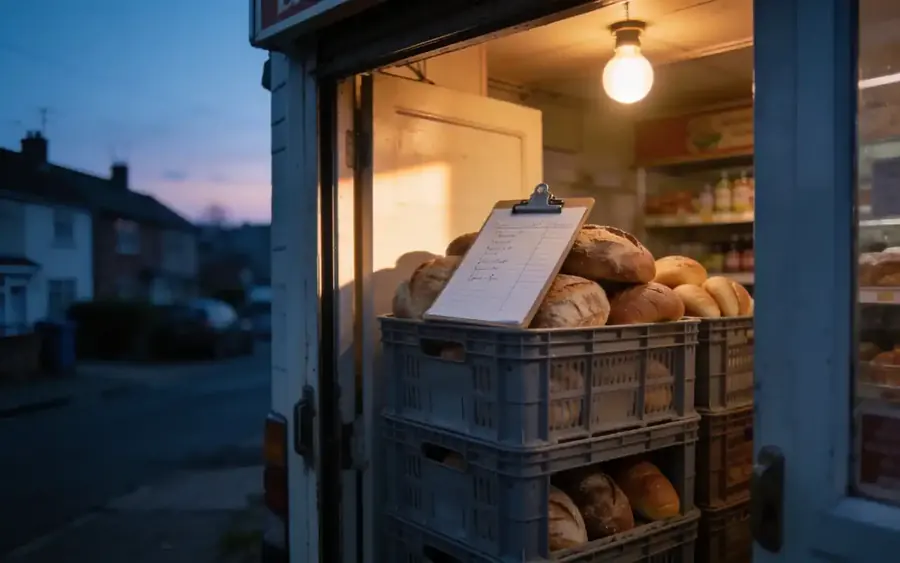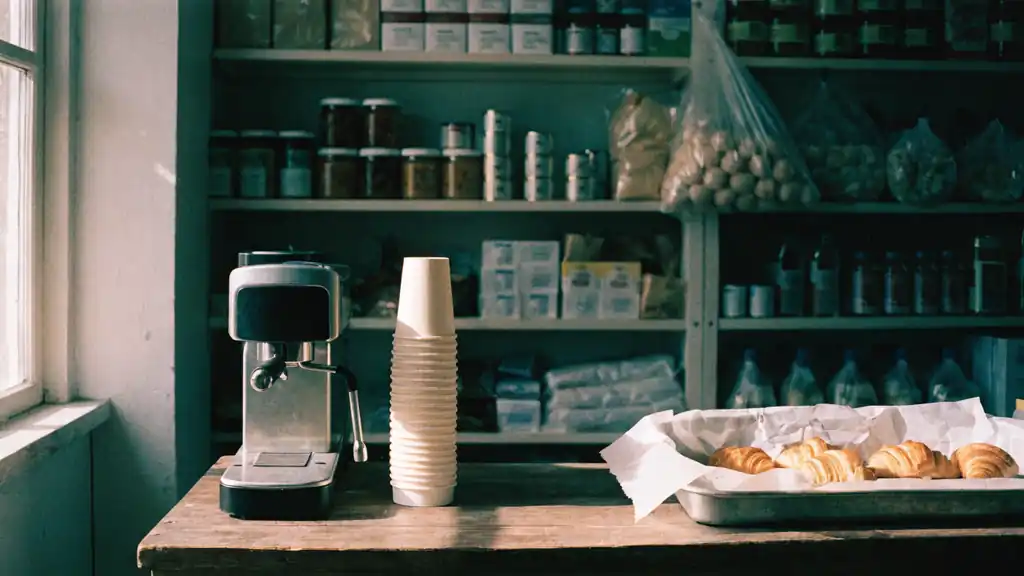
A coffee counter is the extension most small shopkeepers think through at least once. And for good reason: few products carry this kind of margin, and few bring the same person back this regularly. Someone who drinks their coffee at your place in the morning will, eight times out of ten, come in tomorrow as well — and not only for the coffee.
But a coffee counter isn't a product, it is an operation. You put a tin on the shelf and from then on it stands there by itself. A coffee machine has to be started every morning, refilled during the day, cleaned every evening and washed through more thoroughly once a week. That is the difference between goods on a shelf and a service behind the counter — and it is exactly what most calculations leave out.
This article isn't about whether it is worth doing. It is about WHEN it is worth doing: above what count, with what kind of start, and at what cost. The numbers differ by shop, but the method is the same — and two or three weeks will tell you which side you are on.
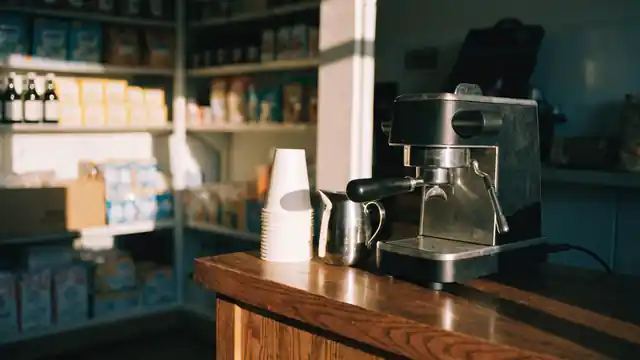
Why coffee in particular?
Three things make coffee special in a small shop. The first is the margin: few products have such a low ingredient cost against the price people will pay. The second is habit: coffee is a daily ritual, so it isn't a one-off sale but a returning customer. The third is the timing — coffee is bought in the morning, in the hour when the shop is open anyway and when most shops are otherwise quiet.
And there is a fourth that is harder to measure: coffee changes what your shop is for. Someone who used to come in to "do the shopping" will now also "pop in". In the longer run that difference is worth more than the margin on the coffee itself — but only if the coffee is genuinely good and always the same.
The threshold moves from shop to shop because the machine cost, the price you can charge and the time it takes are all different. In a village where a coffee sells for less you need a higher count; next to a busy bus stop, fewer will do. The next section works out your own threshold.
What does a cup cost — and what is left on it?
One trap with coffee is that we only think about the coffee. Yet at least five items stand behind every cup served, and together they are no longer negligible. Important: the table below doesn't give actual prices — those differ by shop and by country — it shows WHAT has to be added up.
| Item | What is in it? | What to watch |
|---|---|---|
| Ingredients | Coffee, milk, sugar | Milk often costs more than the coffee — recalculate for milk-based drinks |
| Packaging | Cup, lid, stirrer, napkin | A bigger item for takeaway than you'd think; the lid often costs more than the cup |
| Machine and water | Rental or depreciation, descaling, filter, electricity | This is the fixed part: it runs even on a day when five cups sold |
| Cleaning and time | Daily and weekly cleaning, the minute spent serving | The most frequently omitted item — and the dearest |
| Loss | Spilled, botched, out-of-date milk | A small item but a regular one; allow for it in advance |
The practical yardstick is this: take the ingredient and packaging cost per cup, subtract it from the price, and the contribution you are left with has to cover the machine's monthly cost and the time spent. Divide that by the number of days and you have your own threshold: how many cups a day you need to break even.

The threshold: how many cups a day?
In most small shops the answer is between twenty-five and forty cups a day. Below that the machine's fixed cost and the time spent eat the profit; above it things improve quickly, because the ingredient cost is low and the fixed part doesn't grow any further.
If you don't have coffee yet you cannot measure the count — but you can estimate it. Count for a week how many people come in between seven and nine in the morning. Experience suggests ten to twenty per cent of them will become coffee buyers in the first months, and that share grows as people get used to it. If your morning customer count is below thirty, coffee probably won't pay for itself on its own — but it can still make sense if there is no other option nearby and the customer gets into the habit of coming to you.
What does it cost to start?
| Option | Who is it for? | What to expect |
|---|---|---|
| Supplier's machine with a coffee purchase commitment | Anyone starting out who doesn't want a big investment | Little or no entry cost, but a tied coffee price and a minimum volume |
| Rented professional machine | Anyone who already knows the count is there | A fixed monthly fee, servicing usually included; predictable but continuous |
| Your own purchased machine | At a high, stable count | A large one-off outlay, in return the lowest cost per cup |
| Automatic, self-service machine | Where there is nobody behind the counter for coffee | Less work, but weaker quality and less repeat custom |
Coffee, bakery or hot food?
| What you introduce | Work | Risk | Who is it for? |
|---|---|---|---|
| Coffee only | Small: daily cleaning, refilling | Low — coffee doesn't spoil on the shelf | Everyone who would start: this is the entry point |
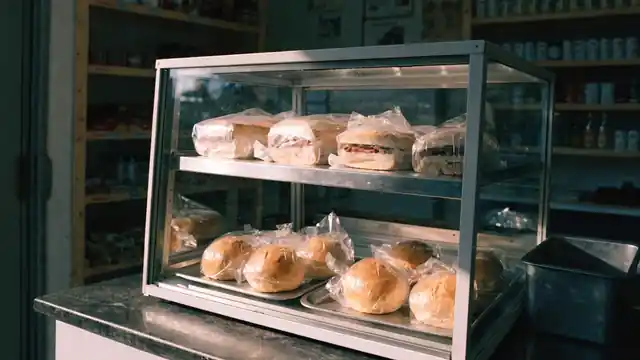
| Coffee + pre-packed bakery | Small to moderate | Moderate: bakery nobody eats is waste | Where there is morning footfall |
| Sandwiches made on site | Large: preparation, chilling, dating | High: waste eats the profit quickly | Where there is a lunchtime peak, not just a morning one |
| Hot food prepared on site | Very large: it needs its own person | High — and separate licences too | Only where the lunchtime trade is certain |
The time nobody counts
If there is one thing to take away from this article, it is this. A coffee counter doesn't fail on the price of the machine, it fails on time. Five to ten minutes to set up in the morning, the same again to clean in the evening, a more thorough wash once a week, and thirty to forty seconds of service per cup. At forty cups that is nearly an hour a day — exactly what would have gone on restocking or tidying the shelves.
We aren't writing this to talk you out of it. We are writing it because if you count it in advance, the decision will be right: either you see that it fits, or you see that you will need an extra person in the mornings — and then you build that cost in too. What leads to a bad decision is the omitted item, not the large one.
How to start — in six steps
- 11. Count your morning customers for a weekA sheet of paper under the counter, one mark per customer between seven and nine. A week is enough to see the order of magnitude, and it becomes the basis of your count estimate.
- 22. Start with the smallest commitmentDon't buy a machine in the first round. A supplier arrangement or a short rental is good precisely because if the count doesn't come after three months you can walk away without an expensive machine left on your hands.
- 33. One coffee, two sizes, nothing complicatedDon't start with twelve kinds of drink. One good coffee, in two sizes, with or without milk. A complicated range slows service down, and whoever is behind the counter has to learn it too.
- 44. Set the price once, and keep itA round figure that rings up the same way at the till. Counting out change every day slows things down unnecessarily, and a constantly changing price damages exactly the trust that brings the morning customer back.
- 55. Measure the count AND the waste for two or three weeksYou need two numbers: how many cups went out each day, and how much bakery was left. Together they tell you whether the counter is producing. If you only look at takings, the binned goods stay invisible.
- 66. Only then extendIf the count is steadily above the threshold, the second step can come: more bakery, sandwiches, perhaps seating. If it isn't there, don't extend — extending doesn't fix a counter that isn't working, it only makes it dearer.
Waste: the food counter's dearest line
With coffee, waste is small. With food it decides the question: a sandwich left at four in the afternoon isn't goods to be marked down and put back on the shelf, it is money thrown away — and worse, it repeats every day. A food counter is profitable if waste stays consistently below ten per cent; above that the margin melts.
- Start with less than you think. Selling out is better news than having leftovers: customers note that it "usually goes early".
- Write down every day what was left. Two weeks reveal the daily and weekly pattern — Monday sells differently from Friday.
- Make the afternoon markdown a rule, not a mood. A fixed time and a fixed reduction works; done ad hoc it teaches everyone to wait for the markdown.
- Don't hide leftovers in staff consumption. If binned goods become the team's lunch, the numbers will show there is no waste — and the decision will rest on bad data.
- Order sandwiches against the COFFEE count, not the other way round. Coffee brings the person in; sandwiches only sell from the trade already inside.

What never to do
- Don't buy an expensive machine without measuring. First the count, then the investment — never the other way round.
- Don't launch coffee and hot food at the same time. They are different operations; launched together you won't be able to judge either.
- Don't leave time out of the calculation. If you only count ingredients, every coffee counter looks profitable on paper.
- Don't let the quality vary. Someone who gets a bad coffee twice won't come a third time — and with coffee this is far sharper than with shelf goods.
- Don't put the machine at the far end of the counter where nobody can reach it. If coffee causes a queue at the till, you are paying for it with the shop's other customers.
- Don't hide binned food in staff consumption. A false number is worse than a missing one.
- Don't start without clarifying the licences. This differs by country — and sorting it out afterwards is always dearer.
Summary
- Coffee's margin is high, but the threshold is the count: in most shops the question turns around 25–40 cups a day.
- The real cost is the time and the fixed machine charge, not the ingredients.
- Start with the smallest commitment: a supplier machine or a short rental, one coffee, two sizes.
- Measure the count AND the waste for two or three weeks, and only then extend.
- With food, waste decides: above ten per cent the margin melts away.
- Licences and hygiene requirements are local questions — clarify them in advance.
Frequently asked questions
Frequently asked questions
How many coffees a day do I have to sell for it to be worth it?
In most small shops the threshold is around 25–40 cups a day, but it depends strongly on the price you can charge and the machine's monthly cost. You get your own figure like this: subtract the ingredient and packaging cost per cup from the price, and divide the machine's monthly cost plus the value of the time spent by what is left. The result is your daily minimum count.
Should I buy a machine or rent one?
For starting out, a supplier arrangement or a short rental is almost always better, because you can get out of it. Buying is worth it once the count has been steady for at least six months and the rental would pay for the machine within a year or two. The order is the same as for any shop investment: measure first, own later.
Is an automatic machine or a manual one better?
That is a question of labour and quality. An automatic takes less time, but the coffee is usually weaker, and it is quality that brings the returning customer back. If there is someone behind the counter anyway and the morning trade supports it, a manual machine gives a stronger result. If there is no capacity to serve, though, an automatic beats a badly handled professional machine.
How much space does it need?
Surprisingly little for the machine itself, but the machine isn't all of it: you need space for cups, for chilled milk, for a bin, and a clear surface where the cup can be handed over. The common mistake is that the machine fits but the operation doesn't — and serving blocks the till. Plan the space around the MOVEMENT, not the machine's footprint.
What do I do if not enough coffee sells?
First check whether people know about it. A surprising number don't notice a coffee counter — a sign on the door and at the counter, plus a line on your social page, helps a lot. Then look at quality and consistency: is it the same coffee every morning. Only after that at the range. If it hasn't reached the threshold after three months, the right decision is to stop — not to extend.
Is it worth making the sandwiches myself?
It is worth it if you have the capacity to prepare them and the lunchtime trade is reliable. Home-made gives a bigger margin, but the waste risk is yours too, and the chilling and dating are separate work. For anyone starting out, pre-packed supplier sandwiches are usually the safer entry: a smaller margin, but some of the leftovers can be returned or keep longer.
How much waste is acceptable?
Around ten per cent is the line above which a food counter's margin melts away. Write it down daily, in pieces and in money. If you are consistently above it, demand isn't small — the order is big, and the answer is less stock, not a better display.
Do I need an extra person for the coffee counter?
Up to about forty cups a day usually not, if service is quick and the machine is next to the till. Above that, or if you also serve hot food, it is worth allowing for an extra person at the morning and lunchtime peaks — otherwise the coffee comes out of serving the shop's other customers. Build that cost into the threshold in advance rather than noticing it later.
How should I price the coffee?
At a round figure that can be handed over quickly and that you can hold. Don't be the cheapest in the area: with coffee the customer rewards quality and predictability, not price. And avoid constant price changes — the morning customer remembers the price and notices any difference at once.
Does a stamp card help?
Coffee is the product where this genuinely works: simple, immediately understandable, and tied to a daily ritual. "Ten coffees, the eleventh free" is clear to everybody. The condition is the same as for any loyalty scheme: it has to be run the same way every day, on every shift — otherwise it does more harm than good.
What about cups and the amount of rubbish?
This is a real and often underestimated item: takeaway service visibly increases the waste generated, and emptying the bin becomes a daily job. It is worth settling in advance where the outdoor bin goes and how often it has to be emptied. A discount for customers' own cups holds some of it back, and some people like it too.
When should I say it wasn't worth it?
After three months, if the daily count has stayed below your own threshold with no upward trend. Importantly, decide this in advance rather than afterwards: write down at the start what figure would make you stop. Without it the coffee counter will survive on the grounds that "we've already bought the machine" — and that is the worse decision.
Coffee is a product too — and just as measurable as the rest.
In Boltom App coffee and sandwiches get their own category and quick code, the till rings them up the same way, and the report shows you by the piece what sold and what went in the bin.
- Its own category and quick code: one tap at the till, no typing.
- Sales per product each day: how many coffees and how many sandwiches went out.
- Daily waste with a reason, in money — the food counter's dearest line, in numbers.
No card needed · 2 minutes