Several hundred people may walk past a small shop every day, and most of them never come in. Not because they don't need anything, but because on the move they never find out that they could get what they are looking for here. They can't see that you are open, they can't see what you sell, and nothing gives them a reason to slow down. The window and the few square metres in front of the shop are where that question is settled.
A good window is not expensive decoration, and it doesn't take a window dresser's talent either. It comes down to a few simple rules: what a passer-by sees in three seconds, how many things you are trying to say at once, how fresh the things behind the glass are, and whether it shows in the evening that the shop is open. Most of this is free; it only takes attention and routine.
This article is about the part you can see from the street: the window, the entrance, the chalkboard and the space in front of the shop. What goes where on the shelves inside is covered in Where should everything go? A shop layout that actually sells more; how people find you online in How people find your shop on Google Maps and in search and How to promote your shop on social media — free and paid; and the wider picture of growing turnover in How to grow a shop's turnover: 12 steps that actually work. The examples are general and can be adapted to any small grocery, bakery or convenience shop.
Three seconds: what a passer-by sees on the move
Someone walking past your shop is in line with the window for roughly three seconds. On a bike or in a car, they get even less. In that time they don't read a paragraph, they don't scan the shelves, and they don't work out what a clever slogan means. They take away one impression, and if it isn't strong enough, they walk on. The three seconds is not a measured rule but a rule of thumb — yet it shows how little time there is.
They need answers to three questions, in this order. If the first two go unanswered, they never get to the third.
- Is it open? Lights on, an open or glass door, a sign put out and clearly legible opening hours all say yes. A half-lowered shutter, a dark interior and boxes standing in the doorway say no.
- What do you sell? It isn't clear from the shop's name, but from what can be seen: bread, vegetables, coffee, wine. One or two characteristic products behind the glass say more than a sign.
- What does something cost? One clearly visible price for a single product — a coffee, a bread roll, this week's offer — says there are no surprises here. Where no price is visible, passers-by often assume it's more expensive.
It's worth crossing to the other side of the street once, looking from there, and then walking past your shop along the pavement at your normal pace. Notice what catches your eye and what simply blends into the building front. If you can, ask someone who doesn't know the shop to do the same and tell you what they saw. Their three seconds are more honest than yours.

The five jobs of a shop window
A window's job is not to be pretty. Its job is to stop someone and bring them in. That can be broken down into five smaller jobs. If your window doesn't do even one of them, the most beautiful decoration is just a backdrop.
| Job | What to do | Typical mistake |
|---|---|---|
| Show that you are open | A bright interior, legible opening hours on the door, a sign put out at opening time. | A dark shop even in daytime, old opening hours in the corner of a sheet, a half-lowered shutter. |
| Show what you sell | One or two characteristic, real products behind the glass, at eye level. | An empty window, a sill used as storage, the back of a shelf unit facing the glass. |
| Give one reason to come in | One current offer or new arrival, in a single short sentence. | Five different promotions at once, in small print, taped over each other. |
| Give a price | At least one product with a clearly visible, accurate price. | No price at all, or the price of an expired promotion that no longer applies at the till. |
| Show that the shop is cared for | Clean glass, fresh goods, a window that is changed regularly. | Faded boxes, dead flies on the sill, the same decoration for months. |
One window, one message
The most common window mistake is not emptiness but clutter. The shopkeeper wants to show everything they sell and announce every promotion they are running. The result is a busy surface on which the passer-by's eye finds nothing to hold on to. If ten things compete for attention in one window, none of them wins.
Every time you change the window, decide on the one thing you want to say right now: fresh strawberries have arrived, you can have a coffee here, cakes can be ordered for the weekend. Everything else should work for that one message, or stay out of the window. If you have two large windows, you can have two messages, but still one per window. Everything else you want to say belongs on the shelves, by the counter or on your social media page.
„A window is not the shop's inventory. It says one sentence, and says it loudly enough to be heard from across the street.”
Products in the window: fresh, real, changed
The strongest element of a window is the goods themselves — provided they are real and look good. A basket of fresh bread, a crate of red apples or a row of neatly arranged jars says more than any sign. But the window is a harsh place for products: the sun beats down on it, it gets hot in summer, the glass steams up in winter, and whatever stands there fades, dries out or gathers dust within days.
- Only put perishable goods in the window if you change them daily and put back what you took out. Wilted vegetables or dried-out bakes are a worse advertisement than an empty window.
- Don't put anything that needs refrigeration in a sunny window — show only its box, an empty pack or a photo of it, if anything.
- The packaging of long-life goods you display fades over time. Change them every week or two, and don't sell faded items at full price or put them back on the shelf as if they were new.
- Only show what is also available inside. If a product in the window has sold out, take it out of the window too, or the customer leaves disappointed.
- Quantity is a message too: a single item in a large window looks forlorn, a pile of them suggests plenty.
- Build height: use boxes, crates or a small table to create several levels, so that not everything lies flat on the sill.
On a small budget
A good window rarely needs a shopping trip. Most props are already in the stockroom or come with your suppliers, and what isn't can be had for very little.
- Wooden crates, fruit boxes, wicker baskets: they make a natural background and are good for raising products up.
- A piece of fabric or paper on the window floor: a plain background that makes the product stand out, and can be changed with the seasons.
- Greenery, flowers and produce of the season: catkins in spring, flowers in summer, walnuts and pumpkins in autumn, fir branches in winter.
- A small lamp or a string of lights aimed at a single point in the window — in the evening, on a dark street, that draws the eye.
- A handwritten card next to the product: where it comes from, who made it, what it's good for. One sentence is enough.
- Your own products as decoration: a pyramid of apples, a row of colourful jars, a pile of fresh loaves.
Chalkboards and A-boards: short, legible, changing
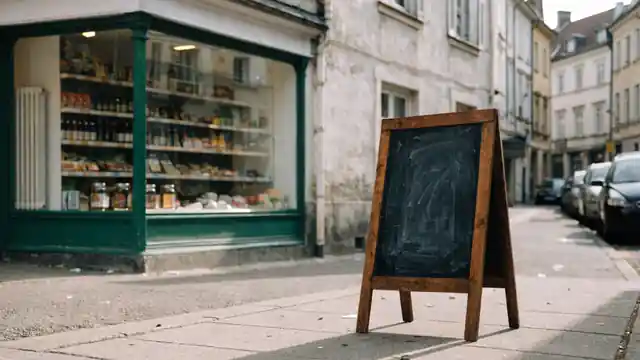
A sign put out in front of the shop is one of a small shop's cheapest and most effective tools, provided it doesn't say the same thing for months. The sign's power is in the change: someone who walks past every day and sees something different each time will eventually read it, and one day come in. If the text never changes, within three days the sign becomes part of the pavement that nobody looks at.
- One sign, one sentence. No more than three short lines that can be read on the move.
- Large letters, strong contrast: white chalk or a chalk marker on a dark board, with letters legible from a few steps away.
- Be specific: "fresh strawberries just in" works better than "come in and have a look".
- If you write a price, it must be accurate, and the same at the till.
- Change it daily, or at least every few days — different in the morning than in the evening, different in rain than in sunshine.
- Place it so it can be seen from both directions, without blocking the pavement.
| When | Sample text | Why it works |
|---|---|---|
| Morning | "Fresh rolls, hot coffee — from 7am" | It tells someone rushing to work two things: what they need is here, and they won't have to wait. |
| Midday | "Sandwich and a cold drink — ready in two minutes" | Lunch breaks are short; the promise of speed is worth more here than the price. |
| Afternoon | "For a snack: fresh savoury scones and fruit" | It speaks to children and parents coming home from school, with a concrete idea. |
| Evening | "Still fresh bread — open until 8pm" | It answers what someone on their way home is asking: is there any left, and are you still open. |
| Rainy day | "Raining? Hot tea and soup inside, in the dry" | It reacts to the weather, which shows the sign was written today. |
| Heatwave | "Ice-cold drinks in the fridge" | Simple, instantly clear, and it speaks exactly when most people are thirsty. |
| Season | "The first strawberries are here" | Something new is the strongest reason to step in, and it reads as news, not as advertising. |
| Price on the board | "Coffee + roll together: [price]" | One accurate price that makes the shop look cheaper and more predictable. |
Make it visible in the evening that you are open
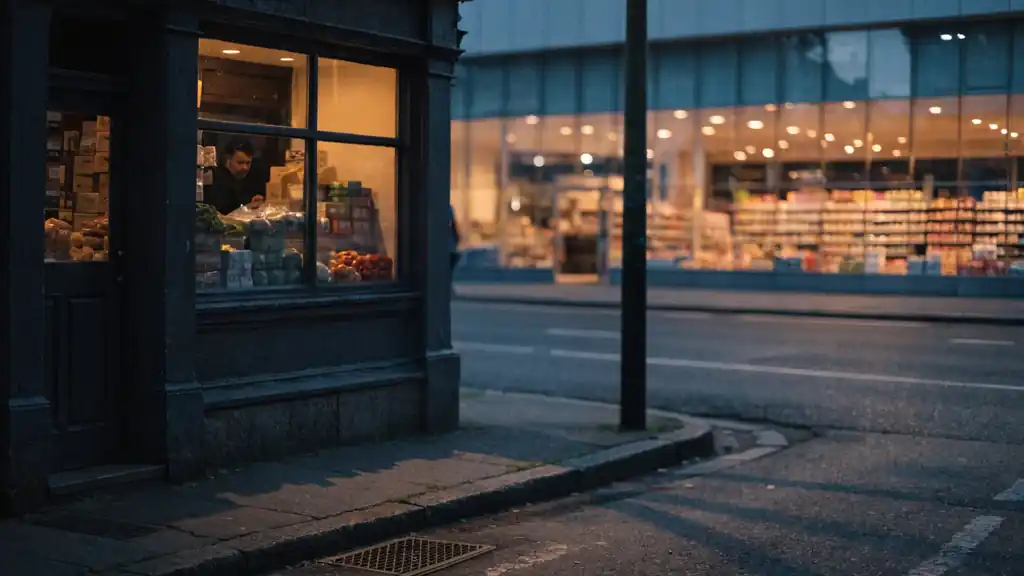
In autumn and winter, much of your opening time is spent in the dark. Then the light in the window is the shop's most important message: a lit window on a dark street says from afar that you are open, a dim one says you have probably closed. Many shopkeepers try to save on lighting during the quiet evening hours, and that is exactly what makes them even quieter.
- The window should be the brightest part of the shop, not the back aisle. From outside, passers-by see the window, not the stockroom.
- Warm, even light is better than glare: cold, bluish tube lighting feels like a hospital, warm light invites people in.
- Aim one lamp at the main product in the window — in the dark, that single lit spot draws the eye.
- Opening hours and the "Open" sign should be legible in the evening too; if needed, light them with a small lamp.
- After closing, a smaller light can stay on in the window on a timer, if local rules allow — so the shop reminds people of itself in the evening even when it is closed.
- Look at it from outside in the evening: is the glass reflecting, is anything glaring, can you see the person behind the counter?
Light costs money, but a window lamp's consumption rarely compares with what one or two customers dropping in during the evening bring. Whether an evening hour pays off overall is worked through in our article How late should your shop stay open? The marginal hour, Sundays and early starts. But as long as you are open, it has to show.
Cleanliness and the entrance: the first step into the shop
Customers don't start judging a shop at the shelf, but at the door. Dirty glass, a corner full of cigarette ends or a soaked, crumpled doormat says it won't be any better inside. Keeping the entrance tidy costs nothing; it just has to be built into the daily routine, like opening the till.
- Windows and door glass: clean inside and out, with no fingerprints. On a busy street at least once a week, and the door every day.
- Pavement in front of the entrance: sweep it in the morning, clear snow and ice in winter and fallen leaves in autumn.
- Doormat: have one, keep it clean, and make sure it doesn't ruck up — a curled corner is easy to trip over.
- Litter: if there is a bin at the entrance, empty it regularly. Cigarette ends and dropped packaging build up quickly, and they reflect badly on your shop.
- Door: it should open easily and not creak, and if a bell announces customers, it should be quiet and friendly.
- Old stickers, expired posters, worn opening hours: scrape off whatever no longer applies. On a door covered in notices, the important information gets lost.
Step-free access and pushchairs
A single step or a door that is too narrow is enough to stop someone from even trying to come in: a parent with a pushchair, a customer in a wheelchair, an older person with a walking stick or a neighbour pulling a shopping trolley. They are often exactly the people who would be the area's most regular customers. You can't rebuild the entrance everywhere, but small steps often help a lot.
- Leave free space in front of and behind the door where a pushchair can turn — not where the crates or the offer basket stand.
- If there is a step, a portable ramp or a clearly visible bell by the door — "Ring and we'll help" — already makes a big difference; for a ramp, check whether you need permission.
- The A-board, planters and goods put out should not narrow the way to the entrance.
- The door shouldn't be too heavy; if possible, fix it open in good weather.
- Inside, the way to the till should be passable with a pushchair, at least near the entrance.
A window calendar for the year
Most windows stay unchanged for months because there is never time to change them, and no plan. If you know in advance what comes when, changing the window becomes an hour's work a month rather than a big job you keep putting off. The calendar below is built on general seasons and occasions; adapt it to your own country's holidays, local events and your range.
| Month | Theme | What to put in the window |
|---|---|---|
| January | New year, clean slate | Tea, soup, vitamin-rich fruit, a simple, bright window after the festive one. |
| February | The end of winter | Hot drinks, baking ingredients, and carnival products if that's a tradition where you are. |
| March | The first signs of spring | Green branches, flowers, seedlings, spring-cleaning supplies. |
| April | Spring holidays | Where there are holidays at this time: baking, eggs, gifts; elsewhere, fresh vegetables and the longer days. |
| May | Garden and outdoors | Barbecue, picnic, fresh salad, cold drinks for the first warm days. |
| June | Early summer | Cold drinks, ice cream, fruit; gifts for the end of the school year, if that's when it ends where you are. |
| July | Heatwave | Ice-cold drinks, ice, food to take to the beach or on an outing — and a shaded window, not a sun-baked one. |
| August | Late summer | Local fruit and vegetables, preserving, and where the school year starts now, snacks and school supplies. |
| September | Back to routine | Breakfast, snacks, coffee, apples, grapes — everyday life starting again. |
| October | Autumn | Pumpkins, walnuts, chestnuts, hot drinks, a warm-coloured background. |
| November | Cold and dark | Soup, tea, baking ingredients, a well-lit window; preparing for the year-end holidays. |
| December | Year-end holidays | Gifts, gift boxes, baking, festive drinks — and the changed opening hours, clearly visible. |
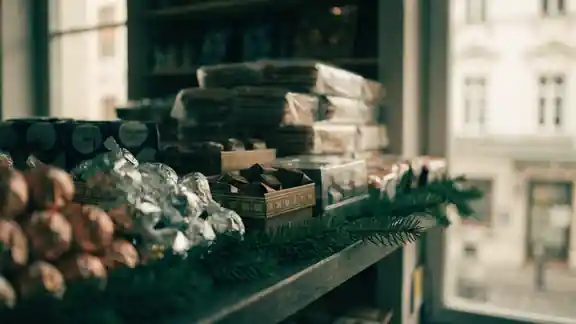
Put the window-change day in your calendar — for example the first Monday of every month — and treat it like a delivery: it doesn't get skipped. Change it a week or two before a holiday, not on the day; customers plan when the window first reminds them. And take the decorations down right after the holiday: a fir branch still out in mid-January says the shop has fallen behind.
How to measure whether it works
The effect of a window is easy to feel and hard to prove. After a new display the shopkeeper is proud, the neighbour praises it, and it seems there are more customers — but perhaps the weather was just better, or it was payday. The reliable measure is the number of sales per hour: how many purchases were made in each hour in the period before and after the change. Not the total turnover, because a single large purchase skews it, but the number of sales — after all, the window's job is to bring more people in.
| Hour | Before: sales/hour | After: sales/hour | Change |
|---|---|---|---|
| 7–9 | 14 | 15 | +1 |
| 9–12 | 8 | 8 | 0 |
| 12–14 | 11 | 13 | +2 |
| 14–17 | 7 | 8 | +1 |
| 17–19 | 12 | 16 | +4 |
- Change one thing at a time: the window, the sign or the lighting. If you change everything at once, you won't know what worked.
- Compare like with like: weekdays with weekdays, Saturdays with Saturdays.
- Note anything that might distort the picture: weather, holidays, payday, road closures, a promotion at a neighbouring shop.
- Look at how the product in the window sold as well: if fresh strawberries are in the window, did you sell more strawberries than before?
- If the number of sales doesn't change, that's a result too: perhaps the window isn't the problem, and you need to look for customers elsewhere.
Common mistakes
- A window plastered with notices. Posters, stickers and handwritten notes on top of each other — passers-by can't see in and don't read a single message.
- An old promotion left up. An expired offer in the window says nobody is looking after the shop, and a customer who comes in for it is disappointed.
- A dark window in the evening. The shop is open but looks closed from outside, and that is what makes the evening hour quiet.
- Faded, dusty goods. Boxes that have stood in the sun for weeks show a neglected shop.
- A window used as storage. Crates, empty cartons, the backs of shelves facing the glass — that's not a window, it's a blocked-off pane.
- An unreadable sign. Small letters, faint chalk, too much text — passers-by can't read anything from it on the move.
- A different price on the sign and at the till. If customers pay something other than what they saw outside, you lose their trust, and in many places it is also against the rules.
- A blocked entrance. Goods put out, the sign or crates mean a pushchair can't get through and passers-by have to walk around.
How to get started, step by step
- 11. Look at your shop from outsideCross to the other side, then walk past the shop at your normal pace, in daylight and in the evening. Write down what you saw in three seconds: whether it's open, what you sell, and whether any price is visible.
- 22. Clean up and clear outScrape off old stickers, remove expired promotions and faded goods, clean the glass and clear the entrance. This step alone makes a visible difference.
- 33. Write down the starting two weeksBefore changing anything, look at how many sales you had per hour in the past two weeks. That will be your basis for comparison.
- 44. Choose one message and build the window around itOne main product or offer, with real goods, a short line of text and at least one clearly visible price. Anything that doesn't work for it comes out.
- 55. Put out a sign and switch on the lightWrite a short line for the day on the chalkboard, and change it daily. In the evening, the window should be the brightest part of the shop.
- 66. Compare after two weeksPut the hourly sales from the two weeks before and after side by side, and look at how the product in the window sold as well. What worked stays; what didn't, change at the next window change.
- 77. Put the next change in the calendarOne window change a month, following the window calendar. Note what you tried and what came of it — after a year, that notebook is your best window guide.
Checklist
- From across the street you can see that we are open and what we sell.
- The window carries one main message, and at least one product's accurate price is visible.
- The goods in the window are fresh, real, available inside, and I change them regularly.
- The sign has a short line for today in large letters, and any price on it is the same at the till.
- In the evening, the window is the brightest part of the shop.
- The window and door are clean, the doormat is in order, and there is no litter in front of the entrance.
- Nothing blocks the entrance, and you can get in with a pushchair.
- There are no expired promotions, old posters or outdated opening hours on display.
- The sign, stickers and anything put outside comply with local rules.
- The next window-change day is in the calendar, and I check the number of sales before and after.
Summary
- A window works in roughly three seconds: in that time it has to become clear that you are open, what you sell, and what something costs.
- The five jobs of a window: show you are open, show your range, give a reason to come in, give a price and show that the shop is cared for.
- One window, one message — with fresh, real goods that are changed regularly.
- The chalkboard works with short, legible, changing text; the change itself is a sign that the shop is alive.
- In the evening light, in the daytime clean glass and a clear, step-free entrance bring customers in.
- With a simple window calendar, a monthly change becomes routine, and you measure its effect on the hourly number of sales, before and after the change.
Frequently asked questions
What should I put in a small shop's window?
One or two characteristic, real products from what you sell, arranged around a single message. They should be fresh and available inside, and at least one product's accurate price should be visible. The window shouldn't be a storeroom, and it shouldn't be covered in promotional posters. A good window says one sentence that can be understood on the move.
How often should I change my shop window?
In a small shop, once a month is usually worthwhile, following the seasons and holidays. Perishable goods in the window need changing daily, long-life goods at least every week or two, because they fade. Put up a holiday window a week or two before the holiday, and take it down right after. If the window stays the same for months, passers-by simply stop looking at it.
What should I write on the chalkboard outside my shop?
A short, specific line for today that can be read on the move. For example: "Fresh rolls, hot coffee — from 7am", "Still fresh bread — open until 8pm" or "The first strawberries are here". React to the time of day and the weather, because that shows the board was written today. If you write a price, it must be accurate and the same at the till.
Do I need a permit for an A-board on the pavement?
In many places yes, because the pavement is public space and using it requires a permit or a notification. There are often also rules on how much clear pavement width must be left for pedestrians. The rules differ from one town to another, so ask your local council or the relevant authority. In the meantime, place the sign so it doesn't get in the way of pedestrians, pushchairs and wheelchairs.
What is the three-second rule?
It's a rule of thumb that a pedestrian is in line with your window for roughly that long while walking past. In that time they need to learn that you are open, what you sell, and what at least one thing costs. It isn't a measured rule, but it shows that a window has to be simple and instantly understandable. Try it: walk past your shop at your normal pace and notice what you see.
How much does window lighting matter in the evening?
A great deal, because in the dark, light is the shop's most important message. A lit window says from afar that you are open, a dim one that you have probably closed. The window should be the brightest part of the shop, with warm, even light and one lamp aimed at the main product. In autumn and winter much of your opening time is spent in the dark, so this is often the cheapest improvement.
How can I make my window look good on a small budget?
Use what you already have: wooden crates, boxes and baskets to raise products up, a piece of plain fabric as a background. Seasonal greenery — branches, flowers, produce — costs almost nothing and instantly sets the season. Your own products are the best decoration when they stand in plenty and in order. A small lamp and a handwritten card next to a product do more than any bought prop.
What should I not put in the window?
Goods that need refrigeration or spoil quickly, unless you change them daily, because they deteriorate in the sun and make a bad impression. Nor expired promotions, faded boxes, crates that belong in the stockroom or posters taped over each other. Don't show a product that has already sold out inside. And don't try to show everything at once — in a cluttered window, nothing stands out.
How can I make my entrance accessible for pushchairs and wheelchairs?
As a first step, keep the space in front of and behind the door clear: no crates, sign or offer basket there. If there is a step, a portable ramp or a clearly visible bell by the door for asking for help can make a difference. The door should open easily, and in good weather you can even fix it open. For any rebuilding and for a portable ramp, check the local rules and your lease.
How do I know whether the new window brought in customers?
Compare the number of sales per hour in the two weeks before and after the change, on the same days of the week. Look at the number of purchases rather than total turnover, because the window's job is to bring more people in. Also watch how the product in the window sold, and note anything that might distort the picture, such as the weather or a holiday. Change only one thing at a time, or you won't know what worked.
Is it worth showing prices in the window?
Yes, for at least one product. Where no price is visible, passers-by often assume the shop is more expensive and don't even come in to ask. One accurate price for a characteristic product — a coffee, a bread roll, this week's offer — says the shop is predictable. Just make sure the price in the window and on the sign is the same at the till, and take down expired promotional prices straight away.
What should I do if my window gets strong sun?
Don't put perishable goods or anything that needs refrigeration in a sunny window, and change long-life products more often too, because the packaging fades. Wooden crates, fabric, ceramics, empty gift packaging and seasonal produce cope well with the sun. An awning or a thin curtain at the back of the window reduces both heat and glare. In summer, let the window show the mood, and keep the fresh goods waiting inside, in the cool.
Say the product's name and it's there on the till.
Boltom App takes the work behind the counter off your hands. You find a product by looking at its photo or saying its name out loud — no codes, no scraps of paper. Whatever leaves the shelf or goes in the bin is recorded right there, not in a notebook. It works alongside your existing till, not instead of it.
- A quick code with a photo — or just say the product's name and the till finds it.
- Staff consumption in three taps, recorded under the person's name.
- Daily waste with its reason: expired, broken, unsellable — totalled up in money.
No card needed · 2 minutes