Shopkeepers have two contradictory bad feelings about social media. One is "this isn't for us, we're not a fashion brand". The other is "we ought to, everyone does it, but I haven't got time". Both come from the same misunderstanding: that social media is about FOLLOWERS.
A small shop doesn't need followers. A small shop needs the people who can walk over in ten minutes. That is a few hundred households — and it is the only audience that counts. A profile with thirty thousand followers of whom two hundred live nearby brings in less than a three-hundred-member street group where everyone lives close by.
That makes the job far smaller than it looks. You don't have to build a content factory, edit videos or follow trends. Two or three honest sentences a week and a photo taken on a phone of what is on the shelf today — that is all. The rest, the things the marketing articles write about, is designed for bigger shops.

Where it is worth being — and where not
The first decision isn't what to post but where. This is where most small shops lose time: they open four profiles, run them all for two months, and all four die. An abandoned profile is worse than none: the customer sees that the last post was two years ago and wonders whether the shop still exists.
| Where | What it does for a small shop | How much work |
|---|---|---|
| Local community group | The greatest local reach. These really are the people nearby | Little — but you must respect the group's rules |
| Your own page | The place for the fixed facts: hours, address, phone number | Little, if you don't aim for daily content |
| Posts on your map listing | Seen by people already looking for you. Good for short, practical notes | Very little |
| Photo-sharing platform | Fresh produce, bakery, vegetables — where the picture sells on its own | Medium: it needs a good photo |
| Short-video platforms | Big reach, but national and young. Rarely converts for a shop | A lot — usually not worth it for a small shop |
One important warning about local groups: they have rules, and most of them restrict advertising. That isn't aimed at you — it is what keeps them usable, by stopping them being flooded with ads. Read the rules, and ask the group's admin if you need to. A shopkeeper who posts once a week about what is fresh and answers questions is welcome everywhere. One who drops in three promotional posters a day gets banned — and after that has no reach anywhere.
What to post: six types that work for a shop
"What should I post" is the commonest question, and the answer is simpler than you'd think: whatever you would say to a customer at the counter anyway. If you wouldn't say a sentence out loud because it sounds empty, it won't work written down either.
- 11. What is fresh TODAY"The bread arrived at noon." "We've just put out the tomatoes." This is the strongest shopkeeper's post, because it is immediate and true. A post like that isn't advertising, it is information — and that is exactly why it works.
- 22. A new product you have brought inEspecially if it is from a local producer, or if somebody asked for it. "Someone asked whether we had lactose-free curd cheese — now we do." That is news and a message at once: that you listen to requests.
- 33. Opening hours and every changeHolidays, seasonal changes, an unexpected closure. This is the most useful post you will ever put out, and precisely the one most people leave out. Customers remember it, thank you for it, and share it.
- 44. A price that is genuinely validIf you have a promotion, write the exact price and the exact period. Never post a price that doesn't ring up that way at the till — that is the mistake that destroys trust in a single comment.
- 55. The person behind the shopWho works there, how long the shop has been going, what happened this week. It doesn't have to be personal: it is enough that the place has a face. This is the type that turns "a shop" into your shop.
- 66. A question you genuinely want answered"Which milk should we bring back?" "Should we open on Sunday morning?" You learn something from the answers, and the people asked feel their word counts — and it does.
How often, and when
Two or three posts a week is plenty. That isn't a compromise, it is the right amount: anyone who posts daily eventually has nothing to say and starts producing filler. And filler is worse than silence, because it teaches your followers to scroll past whenever they see the shop's name.
- The best time is when your customer is deciding what to buy: early morning and early afternoon. An evening post is nice, but by then supper has been bought.
- Post about fresh stock WHEN it is actually there — not the night before, not the next day.
- Post a change of hours at least a week ahead, then again the day before.
- Have a fixed day. If every Tuesday and Friday you post what is fresh, customers learn it and start looking for it.
- Don't vanish for weeks and then flood them with five posts. Rare but predictable beats erratic.
The photo that sells the shop
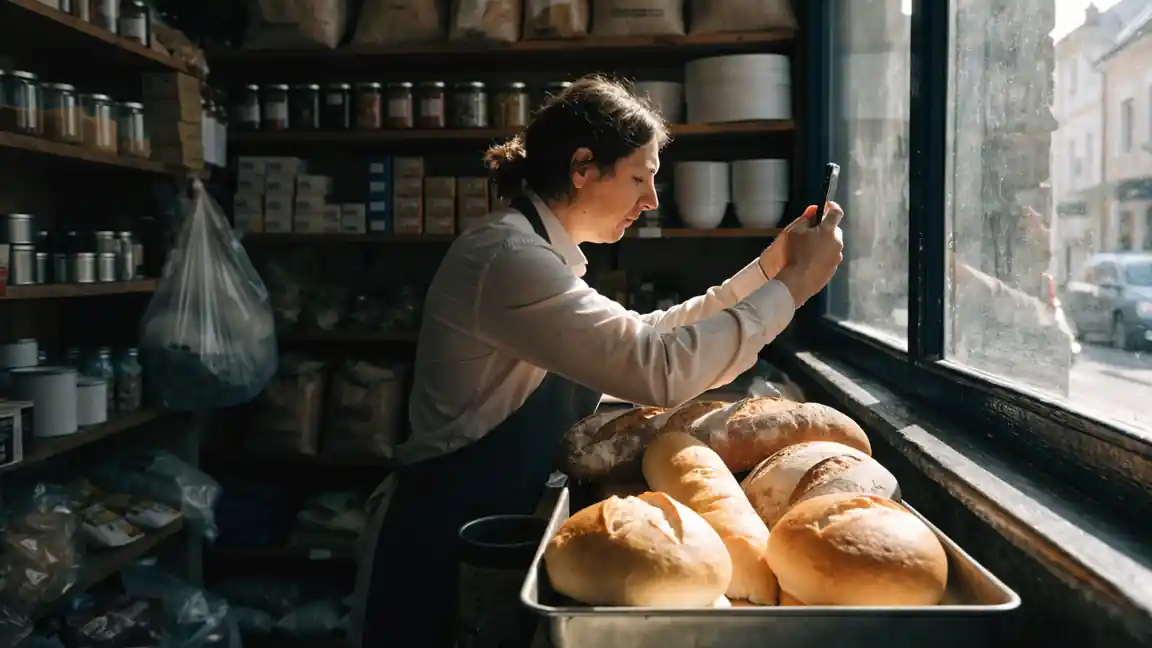
With shopkeepers' photos the question isn't quality, it is truth. A slightly crooked phone shot of this morning's bread is worth more than a perfect picture of bread downloaded from the internet. The first says: "this is here right now". The second says: "we generally sell bread" — which the customer already knew.
- Daylight, preferably from beside a window. Shop strip lights turn everything yellow, and nobody likes a flash.
- Get close. A full shelf is chaotic from a distance; a crate of tomatoes close up is appetising.
- Have a hand or a person in it. The hand putting the stock out says: this is happening now.
- Don't retouch, and don't use heavy filters. The customer is looking for the real thing, and has to find it when they come in.
- If you put a price on the picture it has to be accurate — and when it expires, the post is worth updating or deleting.
- One picture is enough. A ten-picture gallery rarely works for a shop, and loads more slowly.
When it is worth paying
Paid advertising works for a small shop when you promote ONE SPECIFIC thing in a NARROW area. "Come to our shop" is not specific. "Fresh flatbread from ten on Saturday, on Main Street" is. The first burns money, the second brings people in — for the same spend.
| What you advertise | How well it works for a small shop | What to watch |
|---|---|---|
| A specific product, at a specific price, on a specific day | This works best | The price has to ring up that way at the till |
| Opening, reopening, after a refit | Strong: one-off news people want to know | With the date, the address and the map pin |
| A new service (parcel point, coffee, local produce) | Strong, because it is new information | Only advertise what already genuinely works |
| A general "come and visit us" | Practically useless | Don't spend on it — it won't produce a sale |
| Growing follower numbers | Money thrown away for a small shop | A follower isn't a customer, and a bought follower certainly isn't |
On budget, the small shop's advantage is that even a very small amount buys meaningful reach, because the targeted area is tiny. Start with the smallest amount the platform allows and see what happens. If you can't tell whether an advert produced a customer, don't raise the budget — first work out how you are going to find out.

How do you know it is working?
Let's be honest: a small shop cannot measure exactly how many customers came from a post. There is no click-to-purchase path as there is for an online shop. That doesn't leave you blind, though — you just have to watch cruder but usable signals.
- Ask them. "Where did you hear about us?" Two weeks shows where they come from — and that is more accurate than any statistic.
- Watch the sales of the product you advertised. If you promoted flatbread for Saturday and twice as much sold on Saturday, that is a signal. Not proof, but a signal.
- Watch the comments and questions. If someone asks under a post how late you are open, it means it reached people who don't shop with you yet.
- See what gets SHARED. The shared post is the most useful, because the locals' acquaintances are local too.
- Don't follow the likes. A like says nothing about who came in — questions and shares say far more.
And one important addition: for a shop, social media is rarely immediate. It doesn't work by you posting something and people arriving that afternoon. It works by everyone in the area knowing, within six months, that you have fresh bakery in the afternoon too — and coming to you when they need it. That is a slow but lasting effect.
Comments, questions and complaints in public
Once you are present, you will get questions and sometimes complaints — in public. That is frightening at first but is in fact the greatest opportunity, because you aren't answering the complainant, you are answering the next fifty people who read it.
- Answer all of them, the bad ones too. A complaint left unanswered does more harm than the complaint itself.
- Short, factual, no arguing: what happened, and what you are doing differently from now on.
- Don't argue in public. If the matter is complicated, say they should get in touch and settle the detail between the two of you.
- Don't delete criticism unless it is abusive. A deleted comment comes back — and then it is about the deletion.
- If you were wrong, say so. "Yes, that was our mistake, sorry" is the strongest sentence in a shopkeeper's social media.
What never to do
- Don't buy followers or likes. The platforms recognise it, and it doesn't make more locals.
- Don't post a promotion or a deadline that doesn't exist. That is the mistake after which your next, GENUINE promotion isn't believed either.
- Don't post about a product that has already sold out — and if it sells out in the meantime, say so in a comment.
- Don't open four profiles at once. Two that you actually run are worth more than four that die.
- Don't leave an orphaned page. If you give it up, close it or write on it where you can be found — a two-year-old last post says you have shut down.
- Don't copy the tone of the big chains. A small shop's strength is precisely that a person is talking to a person, not a campaign.
- Don't start with social media if your map listing isn't filled in yet. Of the two, the latter brings more customers for less work.
Summary
- The aim is local reach, not follower numbers: three hundred neighbours beat thirty thousand distant people.
- Be present in two places: where the locals talk, and where your details can always be found.
- Two or three posts a week, on fixed days. Filler is worse than silence.
- A real photo of today's shelf, on a phone, in daylight — no retouching, no stock images.
- If you pay: a concrete offer, a narrow radius, a small amount. Never followers.
- Answer every comment, including the bad ones — not for the complainant, but for the next fifty readers.
Frequently asked questions
Does a small shop have to do social media at all?
It doesn't have to, but it is cheap. If you have to choose, filling in the map listing matters more: it is seen by people ALREADY looking for a shop nearby. Social media is for those who haven't thought of you yet — a slower effect, but it costs twenty minutes a week and nothing else.
Which platform should I choose if I only have time for one?
The one where the locals actually are. In most places that is a local community group. Your own page gives less reach, but it is useful for keeping your hours and address findable in one place — which is why it is worth creating regardless of whether you post on it.
How much time does this take each week?
Twenty to thirty minutes in total, if you build it into the day's work. The photo happens while you are putting stock out anyway; the caption is two sentences. If it takes more than that, you are probably trying to do too much: running several platforms, or producing content a shop doesn't need.
What should I post if there is nothing new?
There always is: what is fresh today is always new. Bread, vegetables and milk are news every day, because the customer wants to know what is in TODAY. If there really is nothing, don't post — a skipped week does no harm, an empty post does.
Is it worth paying for advertising?
If you have something specific to say, yes — a small amount, a narrow radius. Specific means: one product, one price, one day. If all you can say is "come and visit us", don't spend on it, because it won't produce sales. Start with the smallest amount and only raise it if you can say what came of it.
How do I measure whether it brought customers in?
Ask them: "where did you hear about us?" Two weeks gives a clearer picture than any statistic. Alongside that, watch the sales of the advertised product on the day. It isn't rigorous measurement, but for a small shop there is nothing better — and it says far more than the number of likes.
What should I do if someone complains in public?
Answer, briefly and factually: what happened, and what you are doing differently from now on. Don't argue, and don't delete the comment unless it is abusive. The answer isn't for the complainant, it is for the fifty people reading — you are showing them that there is someone in the shop who pays attention.
Can I post prices?
You can, and it is worth doing — but only if they are accurate and ring up that way at the till. Put the expiry date on as well. A post containing an expired price does the same damage as wrong opening hours: the customer comes expecting one thing and gets another.
Do I need to make videos?
No. Short video can give big reach, but national and young — for a small shop that rarely converts, while taking many times the work. If you enjoy filming, do it; if not, a good photo does the same local job.
How many followers is good?
There is no good number, and that is the point. The usable question is how many people FROM THE AREA see your posts. A three-hundred-member local group brings in more than a five-thousand-strong national following — which is why follower numbers aren't a goal but a by-product.
What if there is no local group in our area?
Then your own page and the map listing remain, plus paid advertising on a narrow radius. It also happens that there is a group and you don't know about it: it is worth asking customers where people in the area talk to each other. They usually know best.
Who should do it if I genuinely have no time?
A colleague who is good with a phone — but the responsibility for what is true stays with you. The photography and the writing can be handed over; what price appears in the post cannot. An agency rarely pays for a small shop, because credibility, which the whole advantage rests on, is hard to produce from outside.
Post what is actually there.
A good post is one true sentence about today's shelf. In Boltom App you see what sells and what is in — so you don't advertise what ran out yesterday.
- Sales per product: you can see what people really come back for.
- Whatever regularly runs out, you notice before the customer does.
- Promotional prices can be scheduled: the till rings up the right price when it starts.
No card needed · 2 minutes